
Few legal mechanisms trigger as much instinctive resistance as fiduciary security in real estate financing. The mere statement of its principle — a transfer of ownership of the asset to a third party — is often enough to create tension on both sides of the table. The sponsor hears “dispossession” and imagines losing control of their property. The lender, on the other hand, sometimes fears a tool with a reputation for complexity, cost and uncertainty. Yet behind this intimidating vocabulary lies one of the most balanced security interests in French law: a mechanism designed not to confiscate, but to align the interests of the financier and the executor.
The purpose of this article is to dispel the misunderstanding. The lender does not wield fiduciary security as a weapon of dispossession, nor does it offer a promise of absolute protection that would render analysis of the underlying deal unnecessary. It is an alignment mechanism, whose robustness rests on the clarity of its documentation and on the involvement of a neutral third party. Properly understood, it benefits both parties.
What Fiduciary Security in Real Estate Financing Really Is

A Ring-Fenced Asset Mechanism
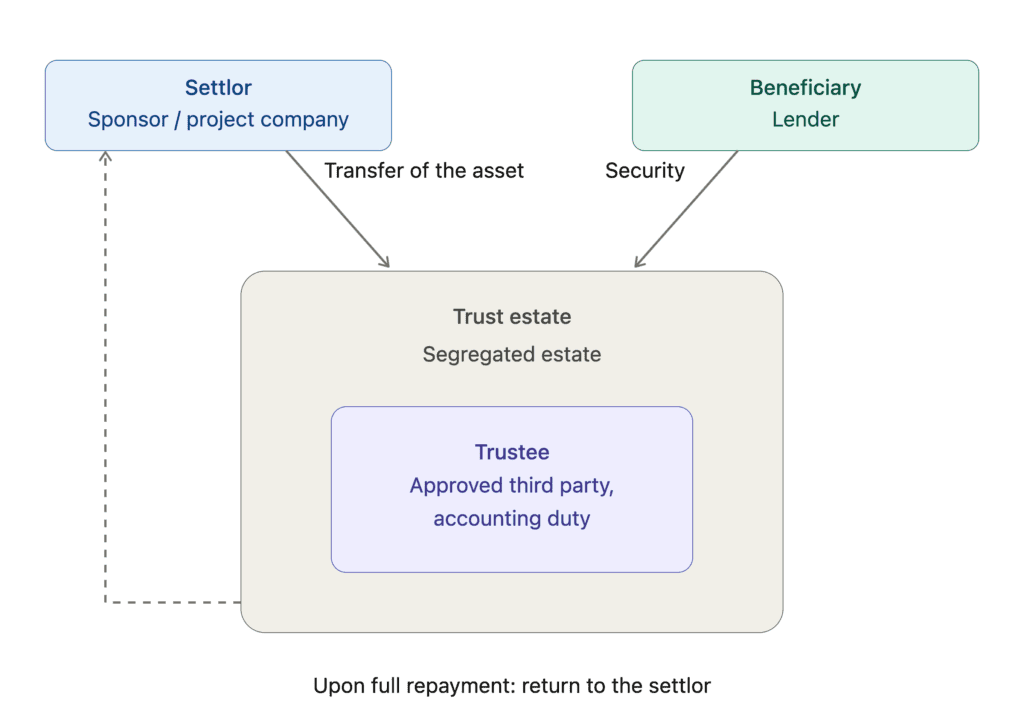
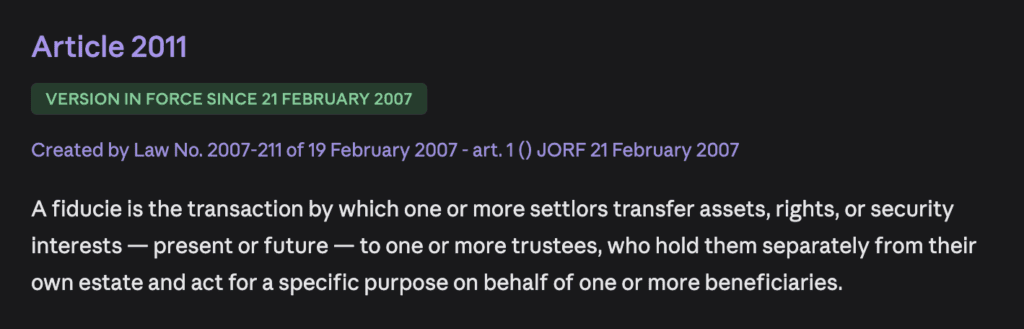
Fiduciary security is the transaction by which a transferor — here, the sponsor or the asset-holding entity — transfers an asset to a fiduciary. The fiduciary holds it in a segregated estate, separate from their own assets, for the benefit of a beneficiary — here, the lender. When this transfer secures the repayment of a debt, French law refers to it as fiduciary security.
The decisive point, often overlooked, is that this transfer is temporary and purposeful. It has only one objective: to secure the loan. Upon full repayment of the debt, the asset reverts to the transferor. Fiduciary security is therefore not a sale: a contract assigns ownership to a guarantee and sets its duration, the fiduciary’s mission and the conditions for restitution.
The Misunderstanding Around “Transfer of Ownership”
This is where the most common fear resides. Transferring ownership does not mean losing use, management or income from the asset. The law precisely organises this dissociation. Where the contract provides for it, the transferor retains the use or enjoyment of the property. They continue to carry out their business, collect rents and manage the letting process. The fiduciary estate holds legal ownership; the economic reality of operations remains, to a large extent, in the hands of the sponsor.
In other words, what the sponsor “relinquishes” is not operational control of their asset, but a legal shell of security, reversible by design. Indeed, this distinction is essential: it sets fiduciary security apart from an outright sale or a sale-and-leaseback arrangement.
A Flexible Scope
Fiduciary security in real estate financing can apply directly to the property and its appurtenances, or to the shares of the company that holds it. This flexibility is valuable in structured finance: transferring the shares of a project company often allows for simpler implementation and faster enforcement than a security interest over the property itself, while preserving continuity of the underlying operations.
Why Lenders Value Fiduciary Security in Real Estate Financing

Resilience Against Insolvency Proceedings
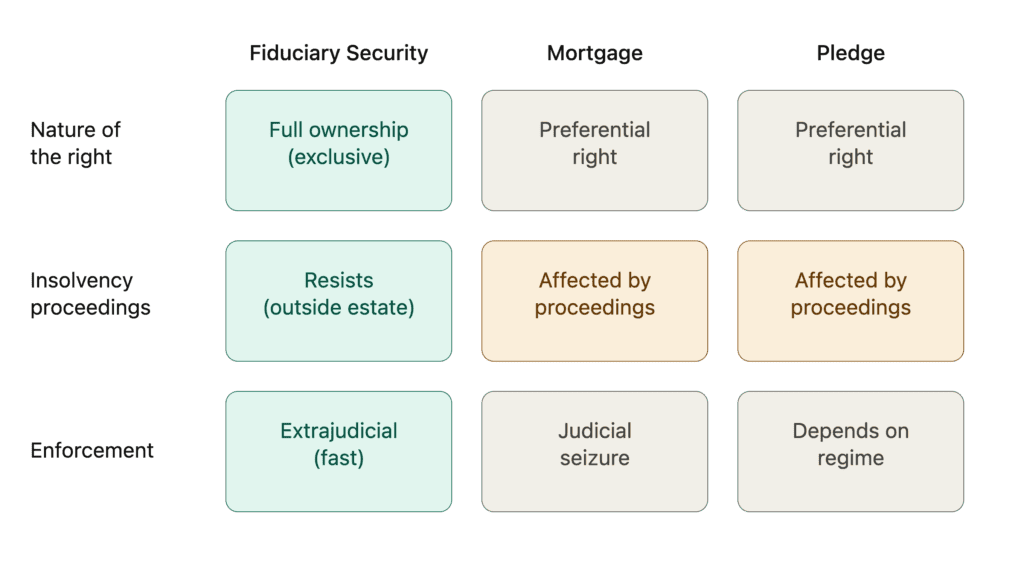
If practitioners describe fiduciary security as the ‘queen of securities’, it is first and foremost for one reason: its effectiveness in the face of the transferor’s financial difficulties. Classic security interests based on a right of preference — chief among them the mortgage — are, to varying degrees, affected by the opening of insolvency proceedings. This includes an automatic stay, imposed restructuring plans, and disrupted priority rankings.
By contract, fiduciary security operates on a different logic. Because the asset leaves the debtor’s estate and enters an autonomous ring-fenced patrimony, it in principle escapes the effects of insolvency proceedings opened against the transferor. The beneficiary creditor thus holds an exclusive position, rather than merely a priority ranking. It is this resilience that underpins the instrument’s reputation.
One important caveat nonetheless applies: where the transferor retains use of the asset through a management agreement…, insolvency proceedings considerably complicate the legal regime. Effectiveness is therefore not “absolute” but conditional on the precise structure of the arrangement. This is precisely why the quality of documentation takes precedence over the mere existence of the fiduciary security.
Extra-Judicial Enforcement
A second advantage for the lender: in the event of default, enforcing fiduciary security does not require the lengthy and costly process of judicial foreclosure. Depending on the terms of the contract, the fiduciary may proceed with the attribution of the asset to the beneficiary or its sale. This speed reduces the risk of value erosion during prolonged proceedings — a particularly relevant advantage for time-sensitive assets, such as a property undergoing repositioning.
Integration With the Broader Security Package
Fiduciary security does not replace contractual discipline — it complements it. It works alongside financial covenants, cash management mechanisms, reserves and intercreditor arrangements. For a lender, it forms the security foundation that organises risk management, rather than substituting for cash flow and business plan analysis.
Why the Sponsor Does Not Lose What They Think They Lose

Retaining Use, Rental Income and Management
The sponsor’s concern is legitimate but largely unfounded where the contract is properly drafted. The management agreement allows them to continue operating the asset as if they had full ownership: collecting rents, managing leases, overseeing works. The fiduciary transfer does not interrupt the economic life of the property.
A Reversible Security Interest
Fiduciary security is, by nature, destined to come to an end. It exists only for the duration of the loan. Upon repayment, the asset returns to the transferor’s estate without any costly transfer formality. This reversibility radically distinguishes fiduciary security from a permanent alienation: the sponsor does not ‘sell’ their asset, but provides security in a manner particularly robust for the lender. In exchange — and this is the essence of the negotiation — they obtain better financing terms.
The Fiduciary: A Neutral Custodian
A final and important point of reassurance: the contract transfers the asset not to the lender, but to a fiduciary. Only strictly regulated entities may perform this function — credit institutions, certain investment firms, lawyers. In practice, the fiduciary acts within a defined mandate, subject to an obligation to account. They are neither the sponsor nor the lender: they are a trusted third party holding the asset in the interest of the contractual purpose. This interposition is precisely what transforms a potential power struggle into an alignment mechanism.
The Safeguards That Make Fiduciary Security in Real Estate Financing Balanced
Specifically, three elements govern the use of fiduciary security and protect both parties.
First, the principle of proportionality: the security must be calibrated to the claim it secures, without manifest excess. Second, the regulated status of the fiduciary, which guarantees the seriousness of the custody and the traceability of management through autonomous accounting for the fiduciary estate. Finally, and above all, the documentation: the fiduciary contract determines, on pain of nullity, the assets transferred, the duration, the identity of the beneficiary and the scope of the fiduciary’s powers. It is in this drafting precision, far more than in commercial bargaining power, that the real balance of the transaction lies.
Key Takeaways
- The sponsor retains, through a management agreement, the use, management and rental income of the asset.
- For the lender, the key advantage is resilience against insolvency proceedings: the asset is removed from the debtor’s estate.
- Enforcement is extra-judicial: faster than a classic judicial foreclosure.
- The fiduciary is a neutral, regulated third party, not the lender: this is the key to the alignment.
- Effectiveness is not absolute: the management agreement makes the regime more complex in the event of insolvency proceedings.
- The balance rests on the quality of the documentation, not on bargaining power.
Risks and Key Considerations
Fiduciary security is neither a neutral nor a cost-free tool, and several limitations must be clearly stated.
The cost and complexity of implementation constitute the first obstacle. The involvement of an approved fiduciary, the drafting of demanding documentation, the registration formalities for properties and the filing requirements generate fees and delays that are not justified for smaller transactions. Fiduciary security is a structured finance inhttps://mosaicref.com/en/alternative-real-estate-financing/strument, not a standardised common-law security interest.
Residual case law uncertainties deserve to be acknowledged. Litigation involving the interaction of fiduciary security with insolvency law remains relatively sparse. Several regime questions — notably the interaction with Book VI of the French Commercial Code and the precise treatment of fiduciary security with a management agreement — retain grey areas that practitioners and academics continue to explore. A robust arrangement must anticipate these uncertainties rather than ignore them.
The tax dimension, finally, must be handled with care. Fiduciary security is subject to a principle of neutrality, but its implementation involves subtleties (registration duties, treatment of income, interaction with group tax regimes) that require case-by-case analysis. The foregoing is provided for information purposes only and does not constitute legal or tax advice.
There remains, finally, the risk of perception. Poorly presented, fiduciary security can alienate a counterparty and derail a negotiation. Upfront education — explaining reversibility, the fiduciary’s role, the retention of use — often makes the difference between a deal that gets signed and one that stalls.
Fiduciary Security Real Estate Financing: Implications for Private Debt and Structuring

It is in the private debt universe that fiduciary security in real estate financing finds its clearest relevance. Where traditional bank financing favours mortgages and standardised credit grids, the private lender often operates in more complex situations: stressed refinancings, repositionings, assets in transition, partial recapitalisations. These are precisely the cases where resilience against insolvency proceedings and speed of enforcement come into their own.
Fiduciary security changes the nature of the conversation. It shifts the debate away from pricing alone towards structure: what the lender actually secures, and what the sponsor actually concedes. Properly used, it allows better terms to be offered to the sponsor, because risk, better controlled, commands a lower price. At the same time, it gives the lender control over the downside scenario. It fits naturally into a “structure-first” approach where covenants, reserves, cash management and control rights form a coherent whole.
Above all, fiduciary security illustrates a truth of structured debt: the best security is not the one that prepares for confrontation, but the one that makes it unnecessary. By clarifying each party’s rights from the outset, it reduces uncertainty and, paradoxically, the very likelihood of litigation. It is a tool of discipline as much as of protection.
Conclusion
Fiduciary security in real estate financing is not the end of trust between sponsor and lender: it is its infrastructure. In reality, the misunderstanding surrounding it stems from one word — “ownership” — whose actual scope, temporary and purposeful, is far less brutal than intuition suggests. For the lender, it offers a level of security that few other instruments can match. For the sponsor, it preserves what matters most: use, management and the prospect of recovering their asset at the end of the loan.
The tool is neither magical nor trivial. It requires careful documentation, a serious fiduciary and constant communication. But on these conditions, it ceases to intimidate and becomes what it truly is: an alignment mechanism in the service of better-structured — and therefore more robust — financing for both parties.
(For information purposes only. This does not constitute investment advice, legal advice or tax advice.)
Sources
- French Civil Code — Title XIV: On Fiducie (Articles 2011 to 2030), Légifrance. https://www.legifrance.gouv.fr/codes/id/LEGISCTA000006118476
- French Civil Code — Article 2024 (effect of insolvency proceedings on the fiduciary estate), Légifrance. https://www.legifrance.gouv.fr/codes/article_lc/LEGIARTI000006445491
- Law No. 2007-211 of 19 February 2007 establishing fiducie; Ordinance No. 2021-1192 of 15 September 2021 reforming security interests law.
- Jeantet — “Démocratisation de la fiducie dans le domaine immobilier”, La Semaine Juridique (LexisNexis), November 2024. https://www.jeantet.fr/2024/11/democratisation-de-la-fiducie-dans-le-domaine-immobilier-la-semaine-juridique-lexis-nexis-novembre-2024/
- Lexbase — “Chronique de droit des sûretés et du financement (septembre 2024 – août 2025)”. https://www.lexbase.fr/article-juridique/123686801-chroniquechroniquededroitdessuretesetdufinancementseptembre2024aout2025
- DS Avocats / Delsol Avocats — “La fiducie-sûreté : un levier stratégique dans la structuration de vos financements”, November 2025. https://www.delsolavocats.fr/La-fiducie-surete-un-levier-strategique-dans-la-structuration-de-vos-financements
- French Senate — Proposal to establish fiducie (Report No. 11, 2006-2007). https://www.senat.fr/rap/l06-011/l06-011_mono.html