
For three years, the European real estate market operated on a simple assumption: rates would eventually fall. Liquidity would return, and values would stabilise at a low point before recovering. Thus, this recovery narrative shaped the bulk of real estate risk premium outlooks published in late 2025 and early 2026. On 11 June 2026, the European Central Bank raised its three key interest rates by 25 basis points. This was its first hike since 2023, bringing the deposit rate to 2.25%. At the same time, the French 10-year OAT reached its highest level since 2009. Within weeks, the core assumption underpinning market reasoning had reversed.
This shift is not a simple cyclical adjustment. Indeed, it strikes at the most structurally significant variable in real estate valuation: the real estate risk premium. That is, the spread between an asset’s yield and the return on a risk-free investment. However, this premium — already thin — has compressed to a level that calls into question the consistency of published valuations. The argument of this article is straightforward: when the risk-free rate rises and prime yields remain frozen, the real estate risk premium falls below its equilibrium threshold. Consequently, this imbalance can only resolve itself one way — through a value correction. That correction is already underway in the secondary market. Nevertheless, it remains latent, though increasingly unavoidable, in the prime segment.
1. Anatomy of a Rate Regime Shift
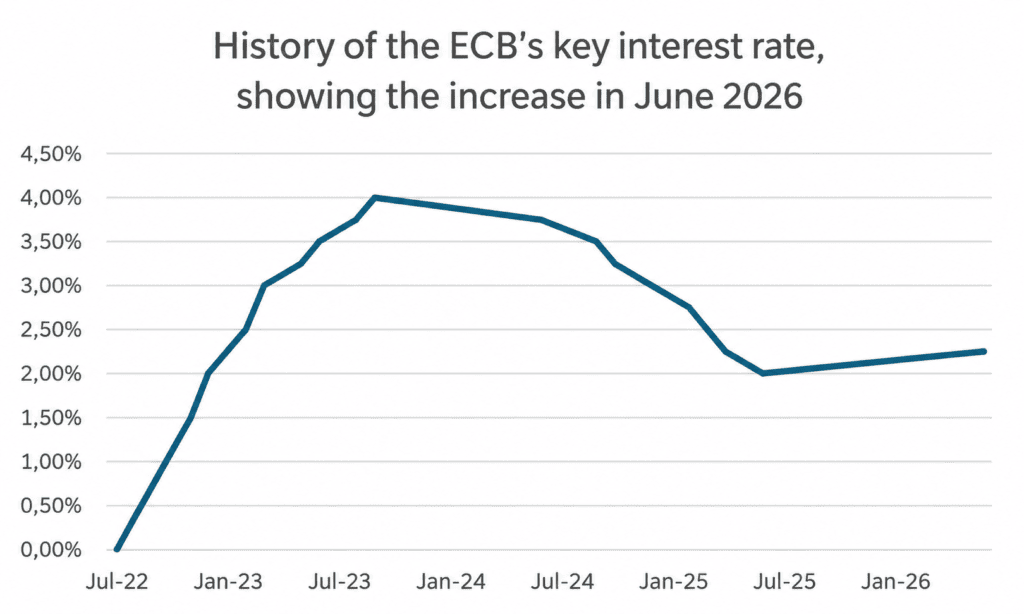
The June 2026 Rate Hike: First Tightening Since 2023

The ECB’s decision of 11 June 2026 marks a cycle break. Indeed, after eight consecutive cuts that brought the deposit rate from 4% to 2% between mid-2024 and mid-2025, followed by a year of stability, the Frankfurt institution is raising rates again. The signal matters as much as the move: this is the first tightening since 2023. Furthermore, markets are already pricing in the probability of a second hike in autumn. The message is clear: the scenario of durably cheap money, which underpinned current business plans, is no longer the base case.
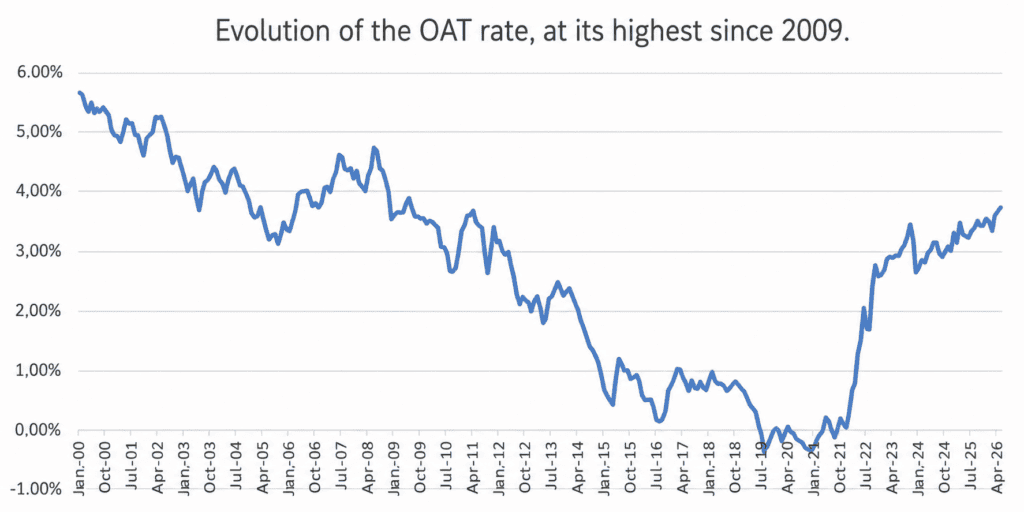
The OAT at Its Highest Since 2009: The Risk-Free Rate Rises
The most consequential move for the real estate risk premium comes not from the short end, but from the long end of the curve. The French 10-year OAT surged by more than 60 basis points in under five weeks. Thus, it reached a level unseen since 2009. This dynamic has a dual origin: a cyclical factor (the return of inflation) and a sovereign factor (French credit risk). The spread between French and German 10-year rates has widened significantly. It reflects an increased risk premium on French sovereign debt, in a context where public debt has risen from around 98% of GDP pre-pandemic to over 116%. For real estate, whose valuation is anchored to the risk-free rate, this repricing of the benchmark is a first-order variable.
An Inflationary Shock Compressing the Real Estate Risk Premium
The nature of the shock matters when assessing its persistence. Energy costs largely drive the resurgence of inflation that justified the monetary tightening. Middle East tensions and disruptions to oil supply routes themselves fuel these costs. This is cost-push inflation, not demand-pull. Therefore, this type of inflation is more resistant to monetary policy and may become entrenched. As a result, a “higher for longer” rate environment becomes plausible, at a time when markets were betting on a swift return to easing.
2. The Real Estate Risk Premium: Mechanics and Compression
Defining the Real Estate Risk Premium
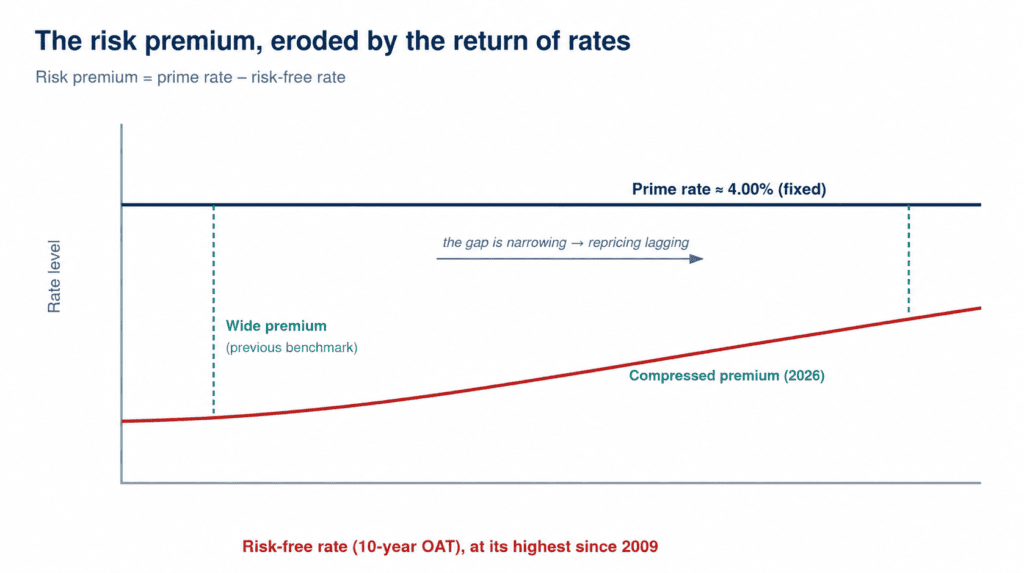
The real estate risk premium is defined, in its simplest form, as the spread between an asset’s prime yield and the risk-free reference rate. It compensates the investor for everything specific to real estate: illiquidity, letting risk, obsolescence, operating costs, and management risk. Note that this market premium differs from the financing spread, which compensates the lender. However, both follow the same logic — when the cost of the risk-free rate rises, both should widen to preserve their function.
A Compression Outside Historical Norms
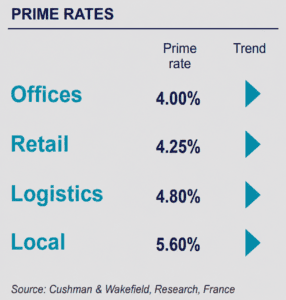
This is precisely what is not happening. Prime yields remained remarkably stable in Q1 2026 — around 4.00% for offices and retail, 4.80% for logistics, and 5.80% for industrial assets in Île-de-France, according to JLL Q1 2026 data. Meanwhile, the risk-free rate climbed towards 3.8%. Mechanically, the real estate risk premium has therefore been crushed. Placed in a long-term perspective, this compression is historically anomalous. Indeed, the historical yield gap between prime real estate and sovereign bonds — outside periods of quantitative easing — sat at a significantly more protective level. Thus, the market is currently pricing real estate risk as barely above that of a government bond — an asymmetry that is difficult to sustain.
The Appraisal / Transaction Gap
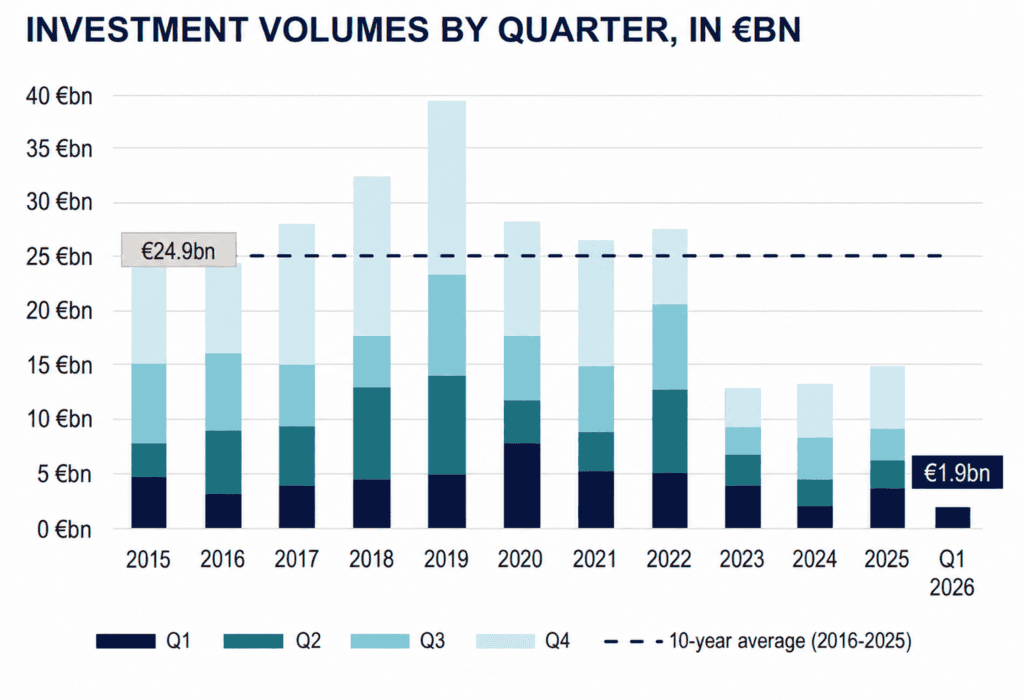
Why have prime yields not adjusted? Because appraisal values and transaction values operate on different timescales. Appraisals smooth, rely on comparables that are becoming scarce, and resist change as long as no transaction materialises to challenge them. Moreover, in a market where volumes are at historic lows — approximately €1.94bn in Q1 2026 according to Cushman & Wakefield — the absence of price evidence allows published values to hold longer than economic reality would justify. This gap is not a protection: it is a deferral. Consequently, the real real estate risk premium is even more compressed than published prime yields suggest.
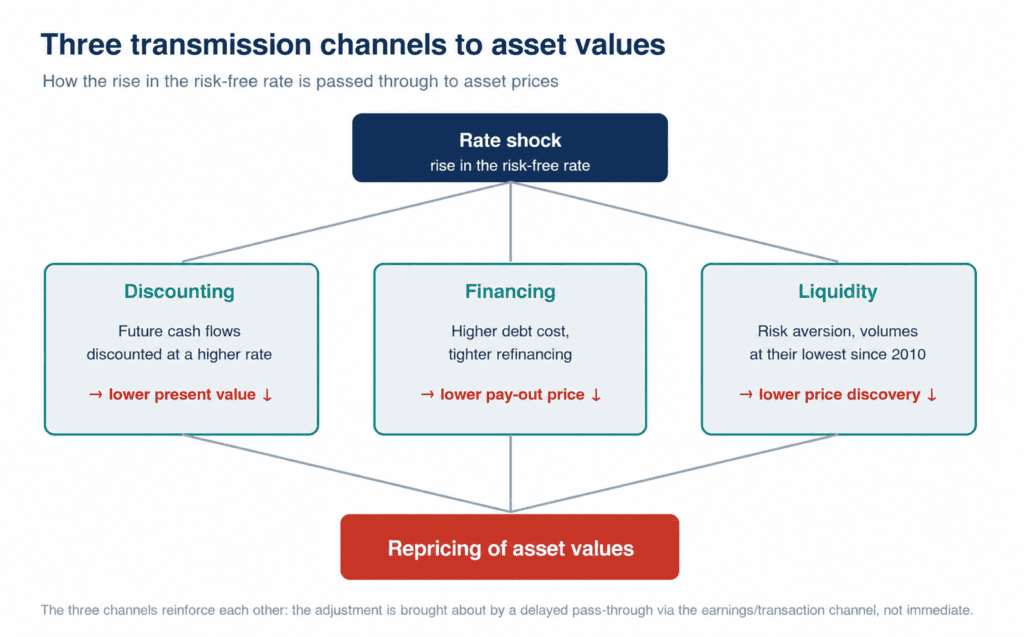
3. Three Transmission Channels to Asset Values
The Discounting Channel for Real Estate Assets
The first channel is arithmetic. The value of a real estate asset is essentially the sum of its discounted future cash flows. When the discount rate — anchored to the risk-free rate — rises, the present value of those cash flows falls, all else being equal. Thus, for a prime yield of 4% to remain justifiable against a risk-free rate of 3.8%, anticipated rental growth would need to be strong enough to compensate. This is possible in some supply-constrained segments, as we analyse in our article on the French office market in 2026. However, this cannot be the general rule.
The Financing Channel and the Cost of Real Estate Capital
The second channel runs through debt. Indeed, rising long-term rates increase the cost of financing and tighten refinancing conditions. An asset whose debt service becomes heavier sees its absorption capacity reduced. Consequently, the price a leveraged buyer can pay falls. This channel reintroduces, through another door, the 2025–2027 real estate refinancing wall: deals that were expected to refinance in a more benign environment now face a tougher equation across value, cash flow, and capex simultaneously.
The Liquidity Channel and Real Estate Yield Discovery
The third channel is behavioural. Faced with uncertainty, sellers and buyers freeze: the former refuse to accept discounts, the latter wait for better visibility. As a result, the market enters a wait-and-see mode, as illustrated by Q1 2026 — investment volumes among the lowest since 2010, concentrated in a handful of large transactions. This illiquidity has a perverse effect: it masks repricing while making it worse. Indeed, the fewer transactions there are, the more price discovery relies on narrow and fragile foundations.
4. Prime vs Secondary: A Two-Speed Correction

Prime: Frozen in Appearance, Under Real Pressure
In the prime segment, supply scarcity and cash flow resilience allow values to hold in published form. This is where available capital is concentrated. Furthermore, more than half of Île-de-France transactions in early 2026 were completed by private investors, more agile than institutional players. However, this resistance is superficial: it reflects the absence of forced sellers, not a healthy real estate risk premium. When liquidity returns, repricing will follow.
Secondary Market: Where the Risk Premium Finds Its Level
In the secondary market, the diagnosis is different: the correction is already here. Persistent vacancy, mandatory capex, entrenched discounts — the economic reality materialises in prices whenever an asset must be sold. Thus, the real estate risk premium finds its way back to a level consistent with the risk-free rate, because the constraint forces price revelation. Ultimately, the behavioural gap between prime and secondary is not a quality dichotomy: it is a temporal lag in price discovery.
5. Risks and Caveats
Several factors could soften or delay the scenario described, and must be stated clearly.
The rate shock may prove transitory. If geopolitical tensions ease and energy inflation subsides, the ECB could pause or even reverse its tightening. In that case, the compression of the real estate risk premium would not lead to structural repricing but to a temporary parenthesis.
Prime supply scarcity may furthermore support values durably. As long as no seller is forced, the absence of downward transactions can sustain elevated values over an extended period — at the cost, however, of atrophied liquidity.
Rental growth and indexation may absorb part of the shock. In segments where rents are rising, higher cash flows partially offset the higher discount rate. This is a genuine cushion, but an unevenly distributed one.
Finally, volume figures must be read with caution. Q1 levels are distorted by the concentration of a few mega-transactions. To interpret this figure as a generalised collapse would be a methodological error.
6. Implications for Private Debt and Structuring
For the private lender, this regime shift alters the risk hierarchy. When collateral value is under latent pressure, protection no longer comes from the headline LTV. Indeed, that LTV is calculated on an appraisal value that may be lagging. Consequently, cash flow and structure become the real safeguard. A robust DSCR, stress-tested under a “higher for longer” rate assumption, is therefore essential. This is precisely the framework we detail in our analysis of private real estate debt in France.
Three Reflexes for Managing Real Estate Risk
Concretely, three reflexes are essential. First, systematically stress-test business plans under a “higher for longer” scenario, not an anticipated easing. Second, tighten structural discipline: calibrated interest reserves, cash sweep on deviation, value covenants at quarterly rather than annual frequency. Third, treat refinancing as the critical variable — timeline, realistic options, and the sponsor’s ability to reinject equity if values contract.
Private Debt as a Response to Repricing
This is also an environment where private debt finds its relevance. Where repricing freezes the market and bank financing becomes more selective, the ability to finance complex real estate operations — transition, repositioning, partial recapitalisation — with enhanced control becomes a competitive advantage. Moreover, security structuring plays a key role in this environment: fiduciary security in real estate financing represents a particularly well-suited alignment tool between sponsor and lender. The complexity premium is all the more justified when risk is, this time, correctly priced.
Conclusion: Where Does the Real Estate Risk Premium Reprice?
11 June 2026 may not go down in history as a spectacular rupture, but it marks a shift in market grammar. The real estate market must stop timing a rebound and start mapping a repricing. The real estate risk premium, crushed by a rising risk-free rate and frozen prime yields, cannot remain below its equilibrium threshold indefinitely. It will normalise — through rental growth where it exists, through value correction where it does not.
The real question of 2026 is therefore no longer “when does the market come back?”, but “where, and by how much, does it reprice?”. Ultimately, for investors and lenders alike, the answer will not be found in appraisal values, which lag, but in the first transactions that dare to reflect the new regime.
(For informational and educational purposes only. This does not constitute investment advice, legal advice, or tax advice.)
Sources
- European Central Bank — Monetary Policy Decisions, 11 June 2026
- Banque de France — Key Interest Rates
- Cushman & Wakefield — France Investment Marketbeat, Q1 2026
- JLL — Real Estate Investment in France, Q1 2026
- Wüest Partner — Between Interest Rate Cuts and Risk Premia
- AEW — European Annual Outlook 2026
- ING THINK — European Real Estate 2026