
The French office market is not “recovering” — it is reshaping itself. And this transformation is becoming increasingly visible. On one side, recent, well-located and energy-efficient assets continue to attract tenants, capital and financing. On the other, older, less flexible and more energy-intensive stock faces persistent vacancy and increasing pressure on values.
It is tempting to attribute this divide to remote work. That would be incomplete. The current polarization is the result of three reinforcing forces: (1) increasing tenant selectivity, (2) the shift of ESG and energy from compliance to pricing, and (3) a financing–valuation chain that has become “business plan-driven.” As a result, the office market is evolving from a market of “buildings” to a market of projects (repositioning, refurbishment, conversion, mixed-use), with execution requirements closer to those of value-add assets — even when labeled as “core.”
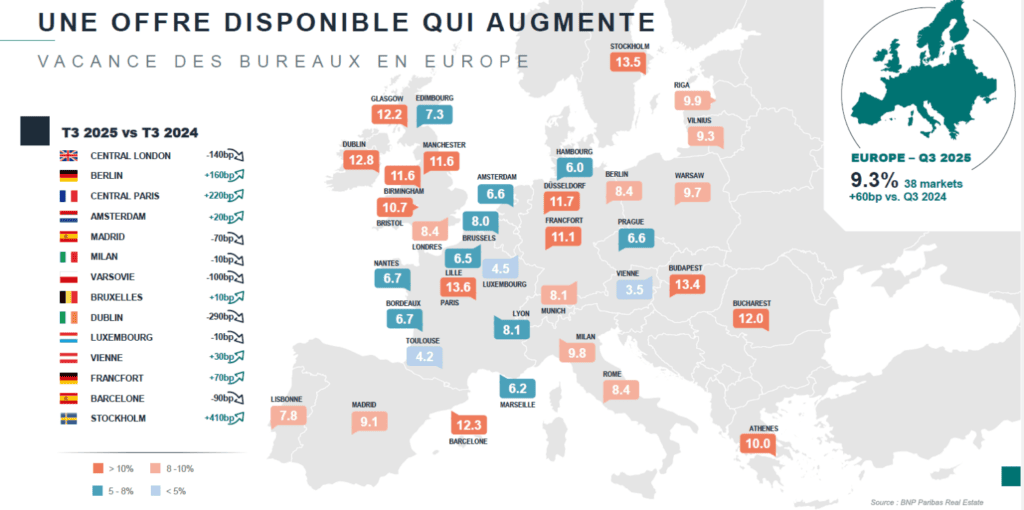
Key takeaways from the French office market
- Leasing activity is increasingly concentrated on “best-in-class” assets (location + quality + energy performance + services).
- Secondary stock is becoming illiquid: vacancy is stabilizing at high levels, leasing timelines are extending, and discounts are becoming structural.
- Headline rents are no longer representative: leasing incentives (rent-free periods, tenant improvements, capex contributions) are once again central.
- Obsolescence is now financial: capex + time + leasing risk = value erosion (“brown discount”).
- Transactions that close are those where pricing reflects the full equation: works / vacancy / financing.
- Conversion strategies are gaining traction but remain case-specific, with technical and regulatory constraints.
- On the debt side, lenders are increasingly underwriting execution capability rather than location alone (capex plan, phasing, pre-leasing, covenants).
French office market overview: reading 2025 to understand 2026
A tenant market driven by selection
Data from 2025 in Île-de-France confirms a now well-established trend: demand remains, but it is shifting and becoming more selective. Companies are no longer simply looking for square meters — they are looking for solutions: less space, better located, more flexible, and more efficient.
Two dynamics are at play:
Rationalization: lease renegotiations, site consolidation, and footprint optimization. Office space remains a closely scrutinized fixed cost, especially as inflation normalizes and indexation becomes less protective than in 2022–2023.
Repositioning of use: for some occupiers, real estate decisions are also HR decisions (attractiveness, employee presence, company culture). This benefits assets capable of offering a credible workplace experience.
In this context, geography still matters, but at a more granular level: accessibility, neighborhood services, building quality and leasing liquidity often outweigh the traditional “Paris vs non-Paris” distinction.
Supply, vacancy and rents: a two-speed market
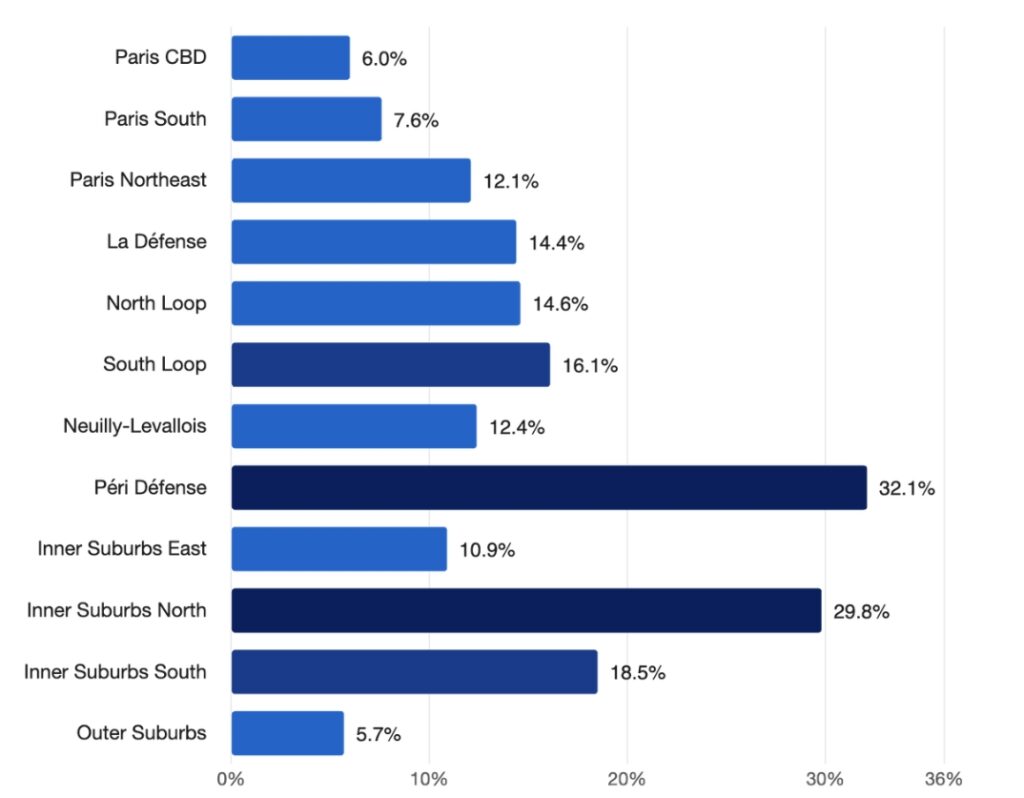
The most structuring factor is the increase in available supply in oversupplied submarkets, with vacancy remaining elevated at the regional level. When supply grows faster than demand, two markets emerge:
The prime market, where supply remains limited (or highly sought-after), and rents are achieved on genuinely differentiated assets.
The secondary market, where supply accumulates, and leasing terms are negotiated as much through incentives as through base rent: rent-free periods, tenant improvements, flexible lease structures.
A key point often underestimated: headline rents may hold, while effective rents decline. At this stage of the cycle, incentives are once again the most reliable indicator of real market conditions.
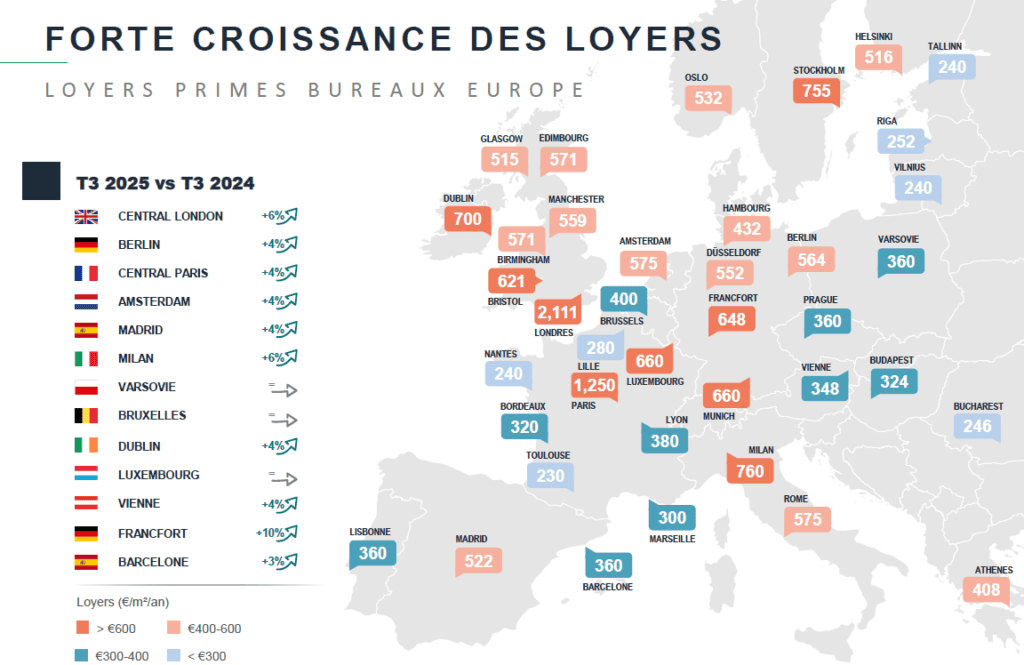
Why the French office market is polarizing
The office as a product and experience
The office is no longer just a physical container. For tenants, especially in competitive labor markets, buildings are tools for:
- talent attraction and retention
- productivity (air quality, acoustics, natural light, thermal comfort)
- collaboration (shared spaces, meeting areas, hospitality)
- employer branding
This creates a quality premium reflected not only in rents, but also in leasing velocity, occupancy stability and absorption capacity.

Conversely, “standard” buildings (inefficient layouts, low ceiling heights, limited amenities) are increasingly difficult to lease, even in acceptable locations. They now compete not only with other buildings, but with alternative ways of working (flex spaces, hybrid models, internal reorganization).
ESG and energy performance: from compliance to pricing
The shift is clear: energy performance is no longer a technical issue — it is a financial one.

In France, the Eco Energy Tertiary regulation sets a trajectory for reducing energy consumption in commercial buildings
This constraint fundamentally changes asset valuation:
- if the building is already compliant: focus shifts to optimization and performance tracking
- if it is not: the market prices in capex, timing and leasing risk
In other words, energy performance becomes a core component of value, alongside location and tenant quality. In oversupplied markets, ESG acts as a powerful selection accelerator: weaker assets fall out of favor more quickly.
A financing–valuation chain that is now business plan driven
Before 2022, many assets could still be financed under relatively simple assumptions. In a higher interest rate environment — as reflected by recent European Central Bank policy rates— and with stricter risk requirements, this model has become less common.

Financing is now based on an executable narrative:
- the real condition of the asset
- required capex and phasing
- leasing strategy and timelines
- downside scenarios
- sponsor execution capability
This reinforces market polarization: the best assets maintain liquidity, while weaker ones accumulate constraints (capex + vacancy + financing), putting downward pressure on value.
How polarization is reflected in transactions
The prime segment: scarcity and competition
In the prime segment, scarcity is twofold: scarcity of truly best-in-class assets and scarcity of sellers willing to meet financing-driven pricing.
Transactions that close typically share common characteristics:
- strong location and accessibility
- new or refurbished assets with high specifications
- visibility on cash flow (tenant quality, lease duration)
- exit liquidity (resale or refinancing potential)
This segment can remain active even in a weak overall market.
The secondary market: structural discounting
In the secondary segment, discounts are no longer just about yield — they represent a budget.
The key question becomes:
“What is the total cost to reposition this asset into a leasable and financeable standard, and how long will it take?”
This is where the “brown discount” becomes embedded: works + vacancy + incentives + cost of capital.
Refurbishment and conversion strategies
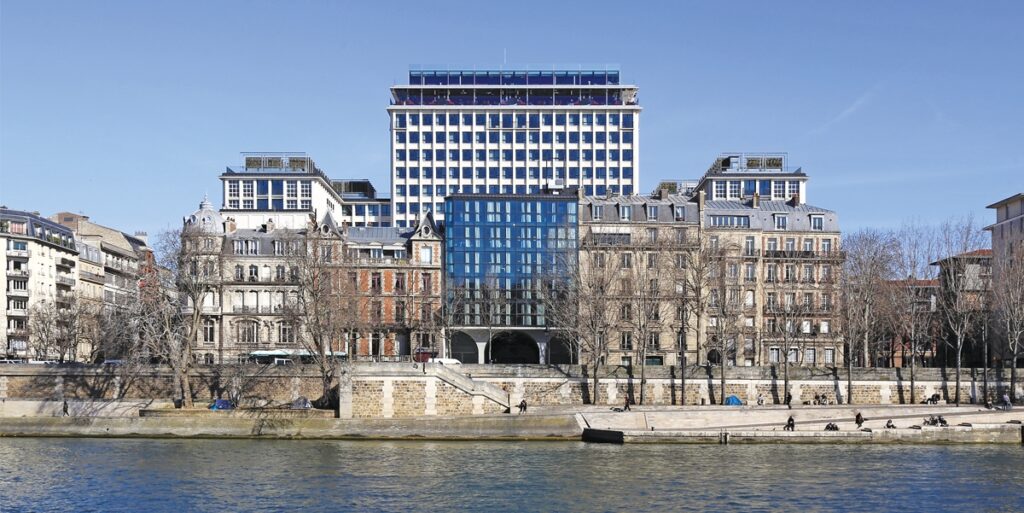
Transformation has become central, but must be approached carefully:
- refurbishment works when location and building fundamentals remain attractive
- change of use works when technical feasibility and economics align
- mixed-use adds complexity across permitting, design and financing
Public policies aim to facilitate conversions, particularly office-to-residential, but execution remains highly case-specific.
Private debt and real estate financing: new dynamics
The current cycle is particularly interesting because polarization directly impacts financing structures. The shift is clear: financing a “market” has given way to financing a plan.
In this context, detailed business plan analysis and execution capability have become central to structuring real estate financing — an approach that also guides transactions reviewed by Mosaic Real Estate Finance.
Key financing criteria in 2026
For lenders, three core areas dominate:
- Cash flow quality
- Capex plan
- Execution capability
How financial structuring is evolving
LTV, LTC, DSCR remain core metrics, but structuring is becoming more project-driven, with:
- escrow accounts
- drawdowns tied to milestones
- cash sweeps
- tailored covenants
- interest reserves
The role of private debt
Private debt is increasingly used for:
- bridge financing
- repositioning strategies
- refinancing situations
Key risks in the office market

Macroeconomic and demand risk
Even if some indicators are stabilizing (inflation, cost of financing), leasing demand depends on a range of factors: white-collar employment, business confidence, and sector dynamics. In a low-growth environment, real estate decisions remain cautious — which primarily penalizes secondary assets.
Execution risk
On transformation projects, the primary source of underperformance is rarely “the market.” It is execution: technical surprises, delays, coordination issues, cost overruns, handover, and re-delivery. A poorly phased project can create a cash-flow gap that is difficult to finance.
Regulatory risk
Regulatory changes may facilitate projects, but they do not eliminate:
- zoning constraints,
- planning regulations,
- technical feasibility (structure, natural light, floorplate layout),
- and local acceptability (parking, amenities, mixed-use considerations).
Liquidity risk
In polarized markets, “theoretical” value only matters if it can translate into a transaction, a refinancing, or a lease. For secondary assets, the risk is prolonged illiquidity, which ultimately forces outcomes (distressed sale, recapitalization, or debt restructuring).
Conclusion: which offices will recover — and at what price?
The office remains a major asset class in France, but no longer behaves as a homogeneous market. Polarization has become a structural divide driven by tenant selectivity, ESG constraints and financing discipline.
In this more selective environment, asset analysis and financing structuring are critical — an approach central to Mosaic Real Estate Finance.
Sources
- ImmoStat — Communiqué “Résultats ImmoStat T4 2025” (PDF, publié le 8 janvier 2026). (GIE IMMOSTAT)
- JLL — “Marché locatif des bureaux Paris et Île-de-France, Bilan 2025” (communiqué, 8 janvier 2026). (jll.com)
- CBRE France — “Immostat T4 2025 : Immobilier de bureaux en IDF et investissement France…” (communiqué). (cbre.fr)
- Colliers France — “Le marché des bureaux en IDF — Bilan 2025” (étude). (colliers.com)
- BNP Paribas Real Estate — “Marché des bureaux en Europe : la reprise se dessine à l’horizon 2026” (page & visuels). (BNP Paribas Real Estate Pressroom)
- BNP Paribas Real Estate — Carte “Vacance des bureaux en Europe (T3 2025)” (image).
- BNP Paribas Real Estate — Carte “Loyers primes bureaux Europe (T3 2025)” (image).
- Banque centrale européenne — “Key ECB interest rates” (tableau des taux directeurs, historique). (European Central Bank)
- Ministère de la Transition écologique — “Éco Énergie Tertiaire (EET)” (objectifs -40%/-50%/-60%). (Ministère de la Transition écologique)
- APUR — “Transformations de bureaux-activités en logements à Paris” (analyse & ordres de grandeur). (apur.org)