
A family office receives, in the same week and from the same sponsor, two proposals on the same building. The first: enter the project company’s capital alongside the developer. The second: finance the transaction as senior debt equity real estate lender. The dominant reflex is to compare target returns and derive a preference. This is the wrong starting point.
Debt and equity real estate are not two graduations on the same risk scale. Indeed, they are two fundamentally different positions that do not buy the same thing, do not require the same skills, and do not unwind according to the same logic. Treating the allocation as a risk/return dial leads to selecting a position on the one criterion that, in reality, discriminates the least. Therefore, this article proposes a repeatable decision framework, applicable deal by deal, structured around three questions: what am I buying, what am I capable of doing, and how does this line fit within the rest of my portfolio.
1. What You Are Really Buying in Each Debt Equity Real Estate Position
Real Estate Equity Buys a Trajectory
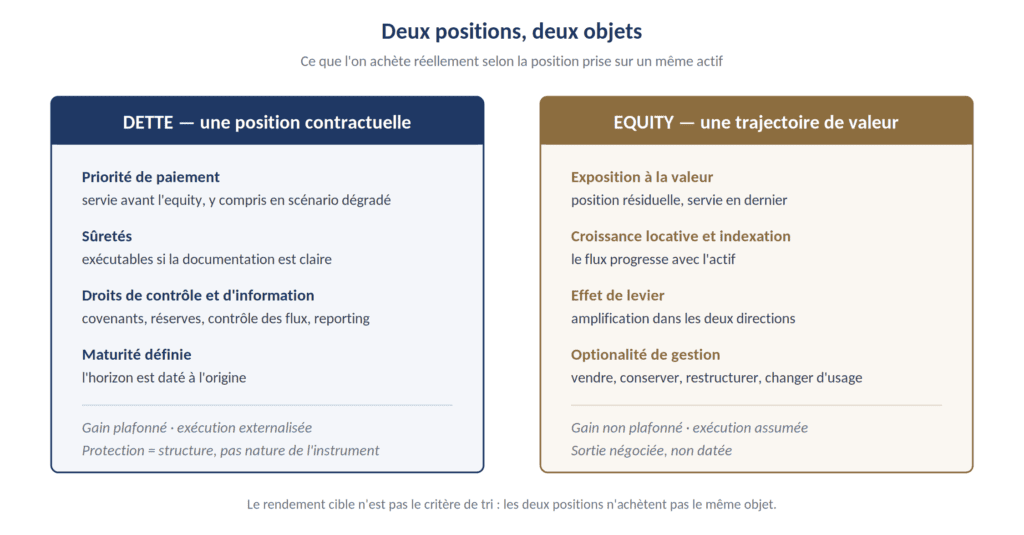
Taking an equity position means acquiring exposure to an asset’s value evolution. This includes everything that drives it: rental growth, indexation, business plan execution quality, leverage, and exit cap rate. The equity investor does not hold a claim: they hold a residual. They receive what remains after charges, debt, and third parties are served. In return, they capture the full upside. They also retain management optionality — the ability to sell, hold, restructure, or repurpose. This is precisely what we analyse in our article on private capital real estate in 2026.
Real Estate Debt Buys a Contractual Position
Lending means acquiring a right to cash flows, governed by documentation. What you buy comes down to four elements: payment priority, a set of security interests, control and information rights, and a defined maturity. The return is capped at the contractual rate. It does not benefit from any improvement if the asset outperforms. However, the position is served before equity, including in a stressed scenario. Its horizon is dated.
The Tipping Point in Debt Equity Real Estate
The structurally defining difference is therefore not the return level, but the asymmetry of the profile. Debt caps its gain, bounds its horizon, and externalises execution. Equity accepts the inverse in both directions: it assumes execution, assumes the exit, and captures the proceeds. Thus, an investor who chooses debt because it “yields less but protects more” has not made an allocation decision: they have recited a textbook hierarchy. Protection does not come from the nature of the instrument. It comes from its structuring — a point developed below.
2. The Real Sorting Criterion: Analysing Is Not Operating

Two Distinct Competencies in Debt Equity Real Estate
The analytical competency involves reading a rent roll, assessing tenant covenant strength, challenging a capex budget, identifying what an appraisal value reflects and what it defers, and understanding credit documentation. It is intellectual and transferable from one deal to the next. It builds over a few years.
The operational competency is of a different nature: re-letting a vacant floor, resolving a construction issue in three days, managing a lease dispute, sequencing works without destroying residual occupation. It is operational, local, and cannot be acquired through reading.
The Practical Consequence for Debt Equity Real Estate
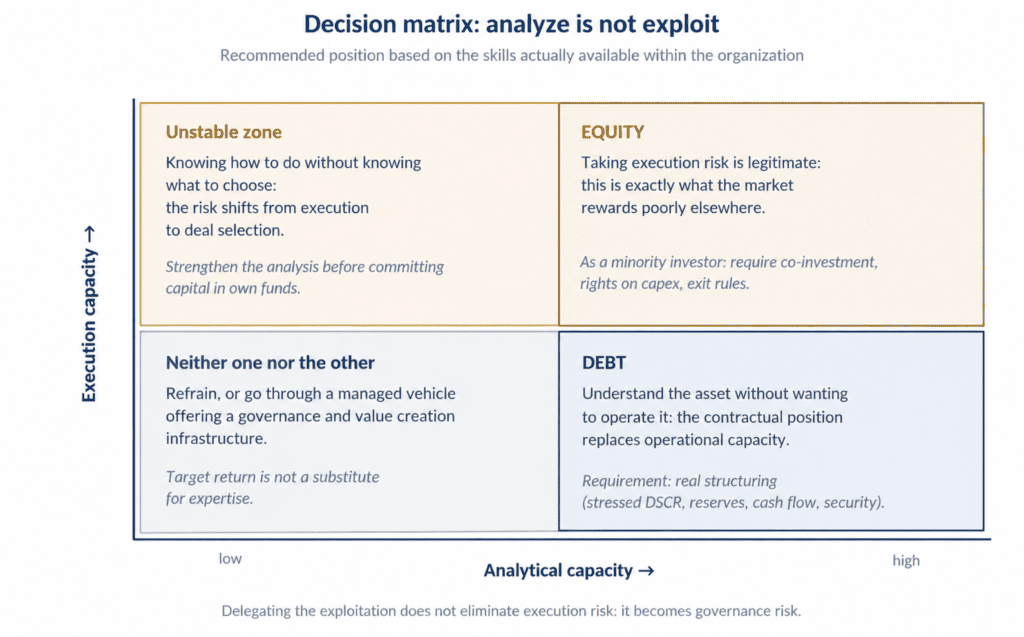
From this distinction flows the most useful rule of the debt equity real estate allocation: equity on what you know how to manage, or have managed with real oversight; debt on what you understand without wanting to operate. A family office with an in-house asset management team, a track record on a given asset type, and a local network can legitimately carry execution risk. This is precisely what it knows how to do. A family office without these capabilities buys, by taking equity, a risk it can neither measure nor correct. This is the framework we detail in our analysis of private real estate debt in France.
The Third-Party Sponsor Case
The objection is immediate: minority equity alongside a professional operator allows precisely for delegation of execution. This is true, but incomplete. Delegating execution does not eliminate execution risk: it transforms it into governance risk. The minority investor then depends on the sponsor’s ability to execute, their actual alignment, and the quality of the rights negotiated at documentation stage. This is not a lesser risk: it is a different risk, less visible, and one that can only be addressed upfront.
3. Horizon, Liquidity and Commitment Structure in Debt Equity Real Estate

A Dated End vs a Negotiated End
Debt dates its own end. Its maturity is contractual, and refinancing or sale constitute identifiable milestones from the outset. Equity dates nothing: it negotiates its exit when the market allows. The trade-off is that this moment may not coincide with the investor’s need.
This difference is particularly structuring for a family portfolio, where liquidity needs are driven by events — estate planning, tax optimisation, external projects — that do not align with real estate cycles. An allocation heavily weighted in unlisted equity across three to five positions creates a real calendar constraint. It is frequently underestimated at commitment stage. This is also what we analyse in our article on the 2025–2027 real estate refinancing wall.
The Cash Flow Profile in Debt Equity Real Estate
Debt produces, in principle, a regular coupon. Equity produces a deferred distribution, preceded by a cash consumption phase. This difference in form has concrete portfolio consequences: a position that distributes finances portfolio charges, while a position that does not distribute must be funded by the rest.
However, an important nuance applies. Debt with capitalised rather than periodically paid interest shares part of the equity time profile. It produces nothing before maturity and concentrates its entire result on the unwind. Consequently, the gap between capitalised-interest debt and an equity position is far narrower than the label suggests.
4. The Grey Zone: Whole Loan, Mezzanine, Preferred Equity
The binary opposition is convenient but approximate. Between senior debt and pure equity lies a continuum: stretched senior, whole loan, mezzanine, preferred equity, hybrid structures with participation mechanisms. Each combines, in varying proportions, value exposure and contractual protection.
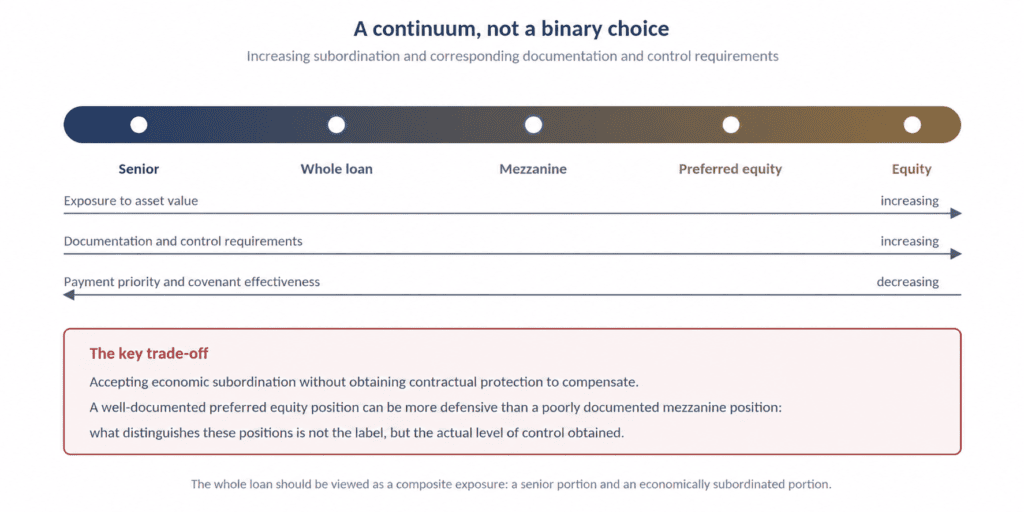
What truly differentiates these positions is not their label. It is the degree of documentary control they confer. A preferred equity with blocking rights, clear governance, and precise distribution rules can behave, in an adverse scenario, more defensively than poorly documented mezzanine. Conversely, a whole loan must be read as a composite exposure. It carries a portion of economically subordinated risk, and must therefore be accompanied by corresponding control.
The central trap is this: accepting economic subordination without obtaining the contractual protection that compensates for it. This is the most frequent configuration of bad surprises, and it is always identified too late. In this regard, fiduciary security in real estate financing provides a particularly well-suited alignment tool between sponsor and lender.
5. Setting the Debt Equity Real Estate Allocation at Portfolio Level
The Hidden Correlation
An investor holding a debt position and an equity position on separate deals from the same sponsor has not diversified: they have doubled their exposure to the same execution capability. The same applies to concentration on a single geography, asset type, or market thesis. Apparent diversification then masks a strong correlation. It surfaces exactly when it is most costly.
A Readable Architecture
A robust framework explicitly distinguishes a defensive core — structured debt positions on understood assets and sponsors — and a value exposure sleeve, sized according to actual monitoring capacity. The useful rule is not a universal numerical split, which does not exist. It is the existence of written limits: by sponsor, by asset type, by vintage, and by unwind date. This is also the thrust of our analysis on the real estate risk premium in 2026.
The Family Governance Question
Finally, the allocation must be documented. A written investment policy — who decides, on what criteria, with what commitment thresholds and what procedure in case of disagreement — is worth more than a shared intuition. It protects above all when the decision becomes difficult, that is, when a deal deteriorates and the choice is between reinvesting and walking away.
6. Risks and Caveats
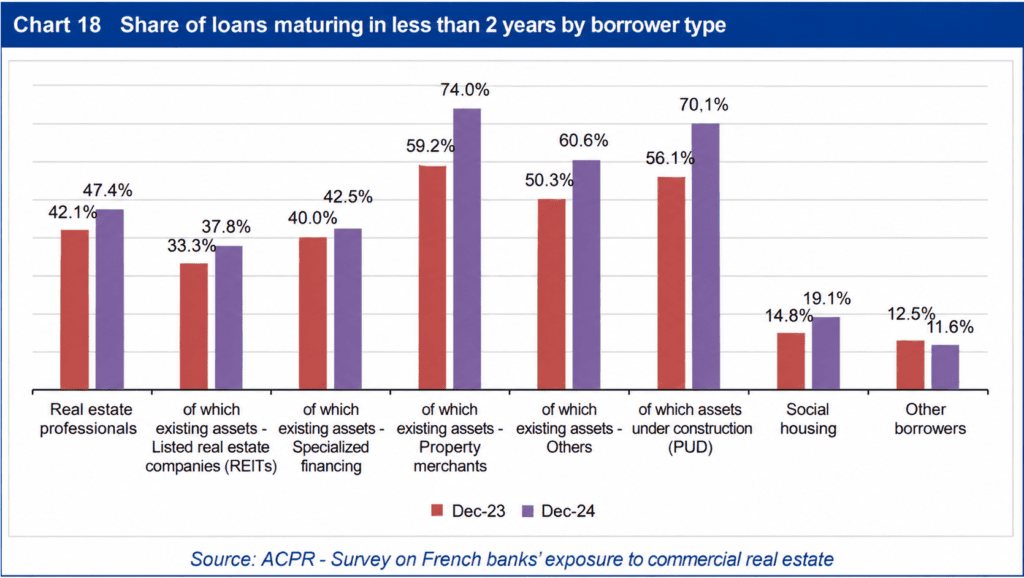
Debt is not defensive by nature. It is defensive by its structure. Indeed, a senior loan with weak documentation, on an illiquid asset, without cash flow control or adequately frequent covenants, offers largely theoretical protection. Conversely, a majority equity position on an asset you know how to operate may prove more manageable than a claim you cannot enforce without lengthy proceedings, according to the ACPR.
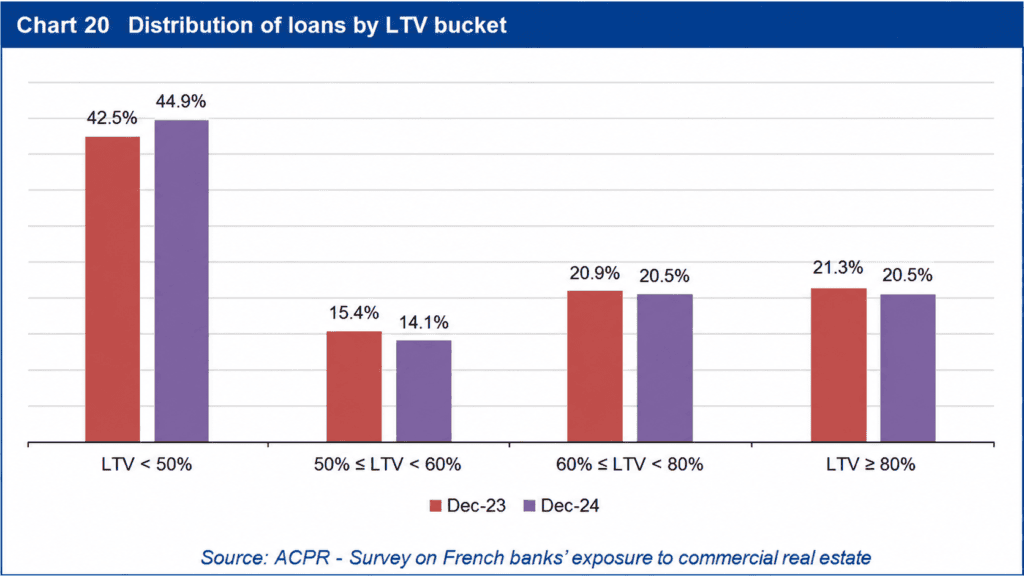
The LTV protection illusion. An LTV calculated on an appraisal value that lags transactions is not a margin of safety: it is a delayed measure. The relevant reference remains the recent comparable transaction.
Minority equity governance risk. The absence of decision rights on additional capex, rules for treating a defaulting investor, or structured exit mechanisms turns a minority stake into a captive position.
Double sponsor exposure risk. It is measured at portfolio level, never at deal level. This is confirmed by the ESRB in its report on vulnerabilities in the EEA commercial real estate sector.
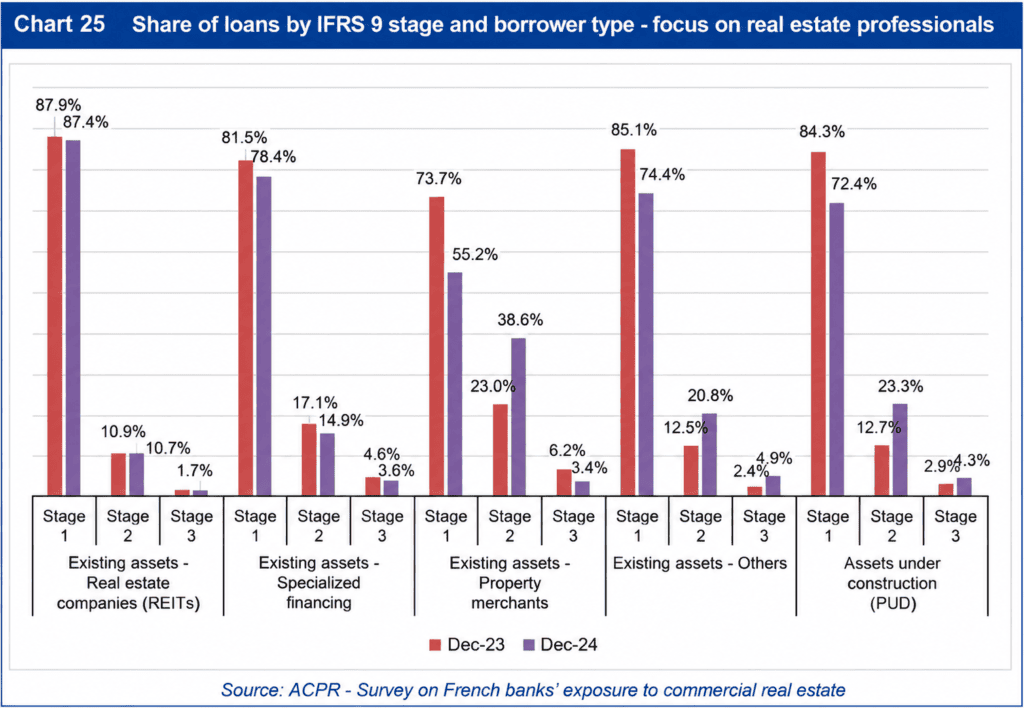
Competency risk. Execution costs and timelines are systematically underestimated by investors who do not operate assets themselves. A twelve-month delay on a re-letting destroys a substantial portion of expected performance.
(For informational and educational purposes only. This does not constitute investment advice, legal advice, or tax advice.)
7. Implications for Private Debt and Structuring
If debt protection comes from its structure, then structuring is not a documentary refinement: it is what determines whether the position delivers on its promise. Four requirements form the foundation.
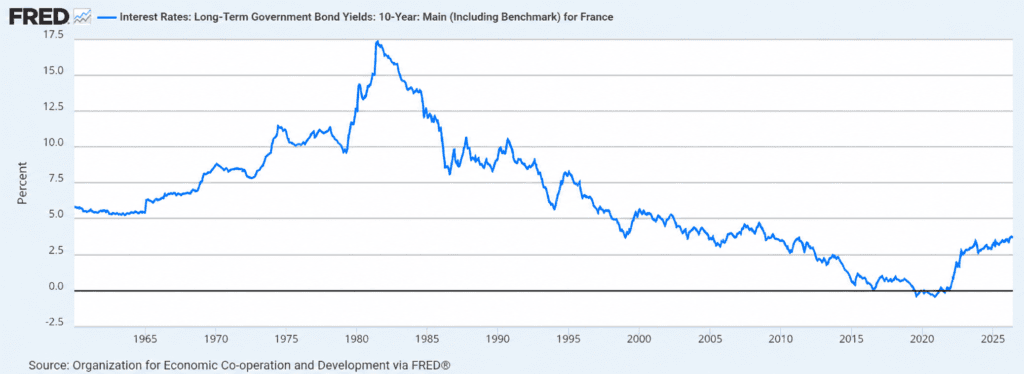
A debt service coverage ratio stress-tested under durably elevated rate assumptions, not anticipated easing. Reserves — capex, interest, leasing — sized for the actual duration of the transition period, not symbolic. Effective cash flow control: dedicated accounts, payment waterfall, distribution lock-up on deviation. Finally, security whose enforcement does not depend on documentary grey areas, as provided by French Ordinance n°2021-1192 reforming security interests law.
Symmetrically, a minority equity position calls for equivalent requirements, transposed: sponsor cash co-investment rather than contribution in kind, decision rights on any significant additional capex, explicit fee policy, exit rules and treatment of a defaulting investor, and reporting with contractualised frequency and content. This is precisely the framework provided by the revised ELTIF Regulation.
The complexity premium is only justified when backed by real control. Without that control, it is merely a headline yield — and this holds true on both sides of the structure.
Conclusion: Debt Equity Real Estate Allocation Is Built Deal by Deal
The debt versus equity real estate allocation is not decided once and for all. It is revisited with each deal, with the same question: not “which one yields more” but “which one matches what I know how to do, over a horizon I can sustain, in a portfolio whose concentrations I understand.”
What distinguishes robust allocations is therefore not the choice made — both positions are legitimate. It is the explicitness of the criterion. An investor who can articulate why they took debt rather than equity on a given deal will also be able to say, two years later, whether their thesis proved correct. One who chose on target yield alone will have, when difficulties arise, no reference point from which to decide.
Sources
- ACPR — Analyses et synthèses n°176, Le financement de l’immobilier commercial par les banques françaises en 2024 (août 2025). https://acpr.banque-france.fr/system/files/2025-08/20250808_AS176_Financement_immobilier_commercial_2024.pdf
- ACPR — Page de publication de l’étude n°176. https://acpr.banque-france.fr/fr/publications-et-statistiques/publications/ndeg-176-le-financement-de-limmobilier-commercial-par-les-banques-francaises-en-2024
- ACPR — Analyses et synthèses n°182, La situation des grands groupes bancaires français à fin 2025 (juillet 2026). https://acpr.banque-france.fr/fr/publications-et-statistiques/publications/ndeg-182-la-situation-des-grands-groupes-bancaires-francais-fin-2025
- Autorité bancaire européenne (EBA) — Guidelines on loan origination and monitoring (EBA/GL/2020/06). https://www.eba.europa.eu/activities/single-rulebook/regulatory-activities/credit-risk/guidelines-loan-origination-and-monitoring
- Comité européen du risque systémique (CERS/ESRB) — Vulnerabilities in the EEA commercial real estate sector. https://www.esrb.europa.eu/pub/pdf/reports/esrb.report.vulnerabilitiesEEAcommercialrealestatesector202301~e028a13cd9.en.pdf
- Banque de France — Rapport sur la stabilité financière. https://www.banque-france.fr/fr/publications-et-statistiques/publications/rapport-sur-la-stabilite-financiere-decembre-2025
- Légifrance — Ordonnance n° 2021-1192 du 15 septembre 2021 portant réforme du droit des sûretés. https://www.legifrance.gouv.fr/jorf/id/JORFTEXT000044044441/
- EUR-Lex — Règlement (UE) 2023/606 (révision ELTIF). https://eur-lex.europa.eu/legal-content/FR/TXT/?uri=uriserv%3AOJ.L_.2023.080.01.0001.01.FRA
- INREV — Dossier « Real estate debt funds ». https://www.inrev.org/dossiers/real-estate-debt-funds
- OCDE via FRED — Rendement des emprunts d’État français à 10 ans. https://fred.stlouisfed.org/series/IRLTLT01FRM156N