
The French commercial real estate market has been described as sluggish for the past eighteen months. The volumes confirm it: commercial real estate investment reached €6.6bn in the first half of 2026. This represents an apparent 9% increase year-on-year. However, it reflects a 29% decline once the PROUDREED portfolio sale to Blackstone for €2.3bn is stripped out. Behind this headline figure, one fact goes largely unnoticed yet carries far more weight: the composition of demand has changed. In Île-de-France, more than half of transactions were completed with private capital real estate investors, through multi-family offices or managers dedicated to private wealth. These deals focus primarily on Core+ and Value-Add strategies, while institutional investors remain largely inactive.
This is not a sourcing anecdote. It is a shift in price-setting power. On mid-market tickets, private wealth is now making the market. Therefore, the question for a family office is no longer whether the opportunity exists: it is what that opportunity truly compensates, and what it demands.
1. What the Institutional Withdrawal Has Really Changed
A Constrained Exit, Not a Value Judgement
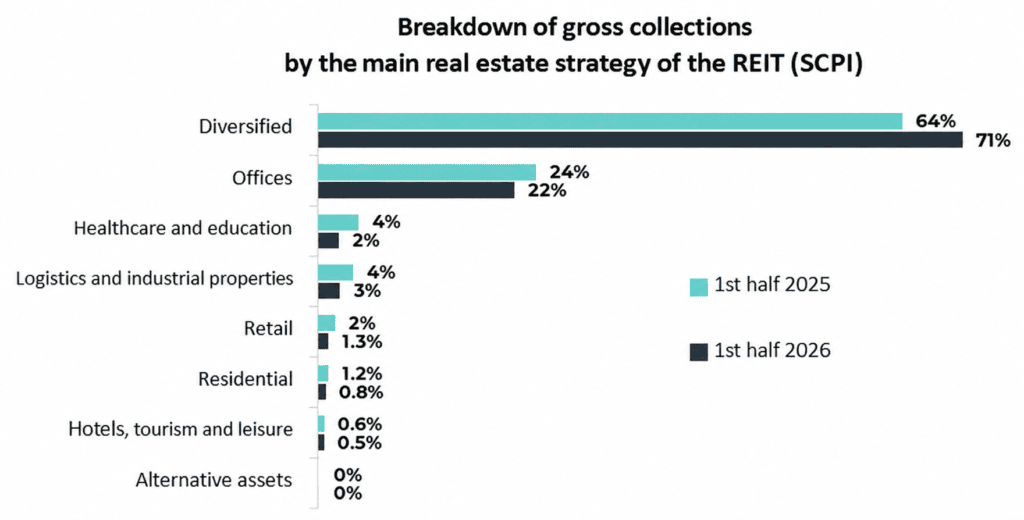
The absence of institutional investors does not reflect a verdict on the asset class. Indeed, it reflects balance sheet constraints. Open-ended vehicles face negative flows that prevent new investment: as of 30 June 2026, SCPI capitalisation stood at €86bn, down 3% quarter-on-quarter. Furthermore, retail OPCIs recorded net outflows of €337m over the semester and saw their net assets decline 11% year-on-year, according to ASPIM/IEIF data. In addition, insurers and pension funds face the denominator effect. A more prosaic difficulty also applies: selling requires booking a loss that appraisal values have not yet reflected.
[Visual n°2 — Investment volumes by quarter in France, 2015 to H1 2026]
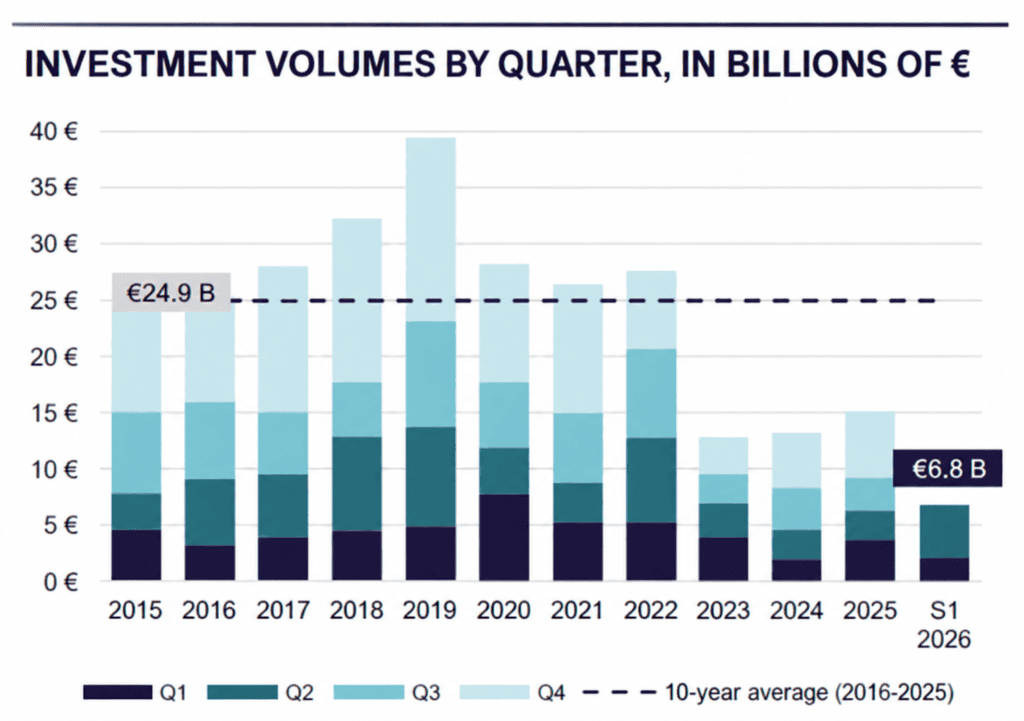
The distinction is essential. A buyer absent because constrained is not a buyer absent because they concluded the asset is worthless. The former will return; the latter will not. This is precisely what we analyse in our article on the French office market in 2026.
Reduced Competition on a Specific Segment
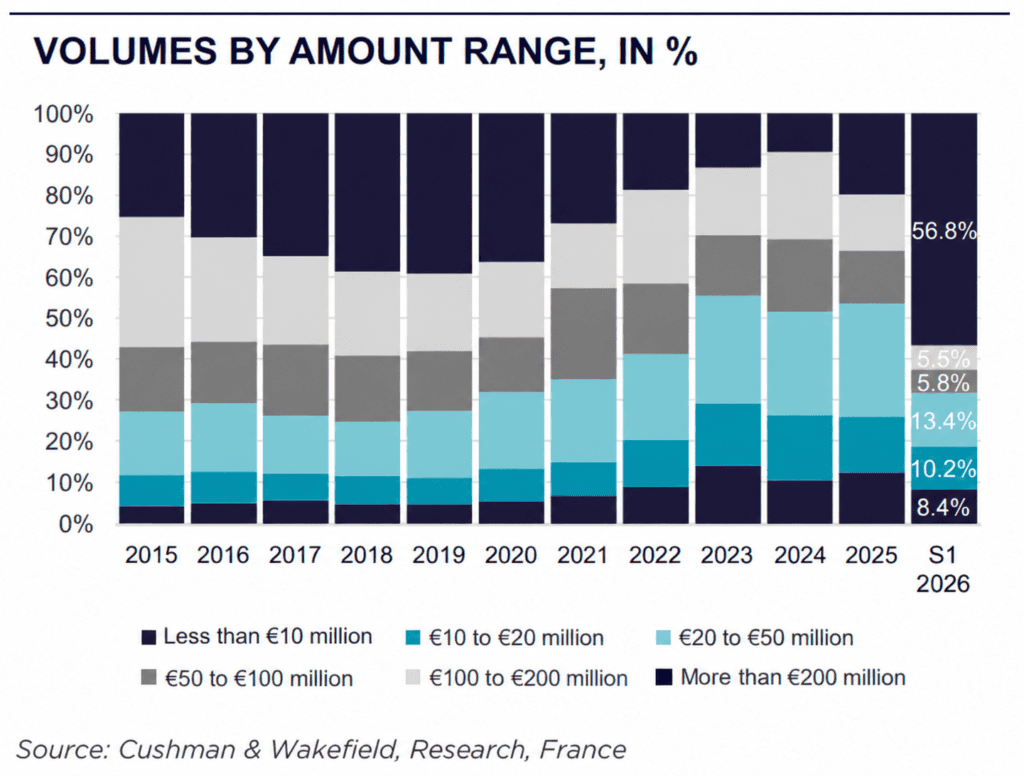
The effect concentrates on mid-market tickets, historically contested between REITs, insurers, and institutional managers. This segment is today too small for the few remaining very large active buyers, and too large for retail savings. Thus, the semester recorded 229 transactions, of which 9 exceeded €100m. These nine deals concentrated 62% of total volume: the market operates at its two extremes, leaving a gap in the middle. The average ticket reflects this, rising from €17m in 2023 to nearly €30m this year, according to JLL H1 2026.
The Immediate Trade-Off for Private Capital Real Estate
Fewer buyers at entry means fewer buyers at exit. This symmetry must be stated upfront. Indeed, it conditions everything else: the competitive advantage of private capital real estate is not free — it is paid for in time horizon.
2. The Edge of Private Capital Real Estate: Time, Not Yield
Three Structural Asymmetries
Family capital enjoys three freedoms that institutional capital does not. First, it is not subject to the denominator effect, which mechanically constrains real estate allocation when listed assets fall. Second, it has no deployment timeline imposed by a contractual investment period. Third, it has no fund life that forces a sale at a fixed date, regardless of market conditions. According to the 11th AFFO/EY Family Office Barometer, real estate investment represents 16% of family office portfolios in 2025, up more than three points year-on-year.
What These Freedoms Enable
These asymmetries enable precisely what the market rewards today. They allow investors to accept an asset with discontinuous cash flow, carry a vacancy of twelve to twenty-four months, and fund capex without quarterly valuation reporting. Above all, they allow fast decision-making. In a market where decision processes are lengthening considerably, speed of execution itself becomes part of the price.

Translation into Asset Typologies for Private Capital Real Estate
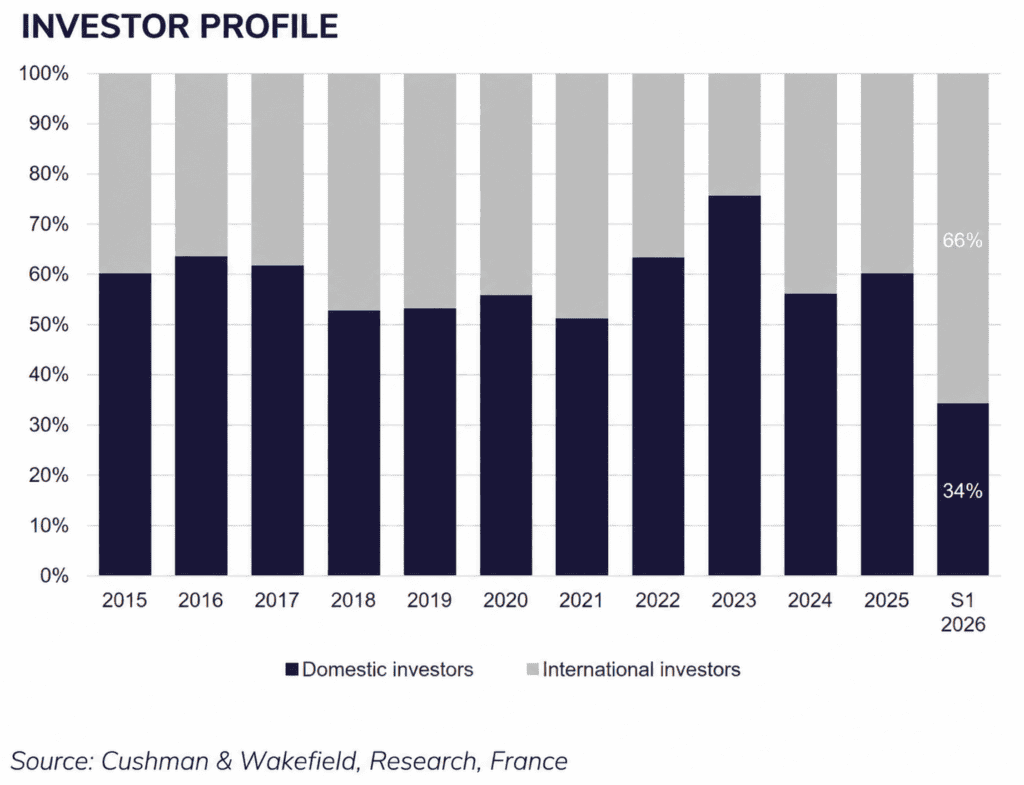
This naturally points toward Core+ and Value-Add rather than pure Core, where international competition remains intense. Family offices do not compete with sovereign funds on prime Parisian assets; they occupy the ground those funds do not descend to. The shift is measurable: value-add strategies represent 42% of invested volumes in H1 2026, versus 19% over the past decade. Furthermore, around 60% of family offices anticipate stable or increased real estate exposure in 2026. This is a strong signal for alternative real estate financing solutions.
[Visual n°6 — Investor profile by strategy (Core, Core+, Value-Add), 2015 to H1 2026]
3. The New Pricing Universe: Where the Yield Gap Pays, Where It Traps
A Reopened Geographic Hierarchy for Private Capital Real Estate
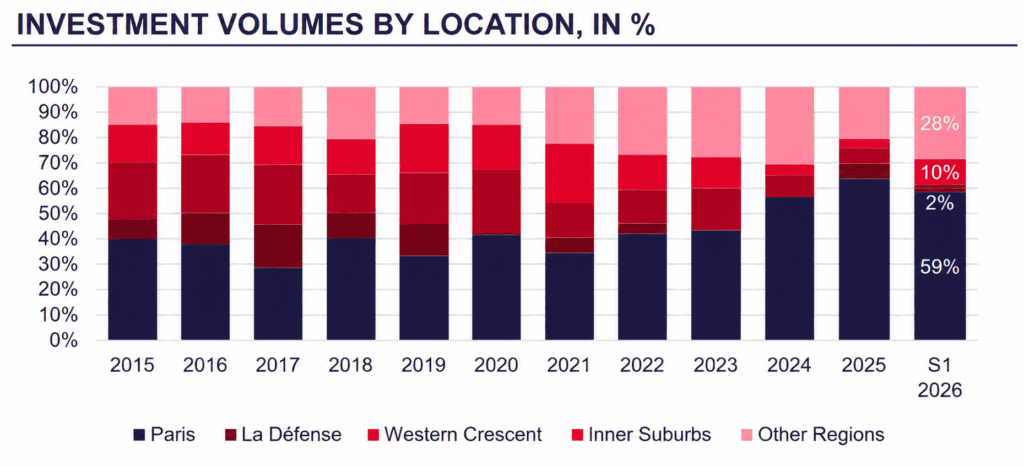
The yield gap between geographies has rebuilt to a level the previous cycle had erased. New benchmarks sketch a differentiated rate universe: 4% in the Central Business District, 6% in the rest of inner Paris, and yields reaching 8% in the first ring. Thus, peripheral Île-de-France and regional markets offer spreads of 175 to 475 basis points above CBD Paris, according to Cushman & Wakefield H1 2026.
[Visual n°7 — Office investment volumes by location, 2015 to H1 2026]
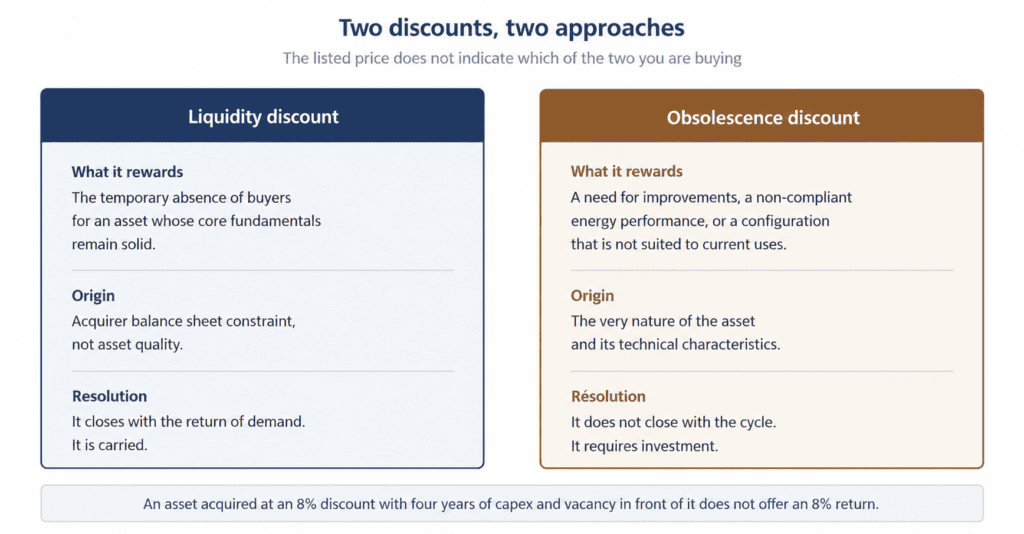
Liquidity Discount vs Obsolescence Discount
This is where execution quality is determined. Two discounts coexist and share nothing in common.
The liquidity discount compensates for the temporary absence of buyers on an asset whose letting fundamentals hold. It closes when demand returns. This is the discount patient capital can capture. In contrast, the obsolescence discount compensates for a capex requirement, a non-compliant energy trajectory, or a layout ill-suited to current uses. It does not close with the cycle: it must be funded. Consequently, an asset acquired at 8% with four years of capex and vacancy ahead does not truly offer 8%. Confusing the two is the dominant error of this market. The asking price does not tell you which one you are buying; only technical and letting analysis does. This is also central to our analysis of the real estate risk premium in 2026.
The Exit Question in Private Capital Real Estate
It must be asked at entry, not halfway through. Who will buy it back? Will the institutional buyer of 2029 acquire what it refuses in 2026? The answer is plausible for a well-located asset whose discount reflects liquidity. It is far less certain for a peripheral asset whose discount reflects its nature.
4. Accessing the Market: Direct, Club Deal, Managed Vehicle
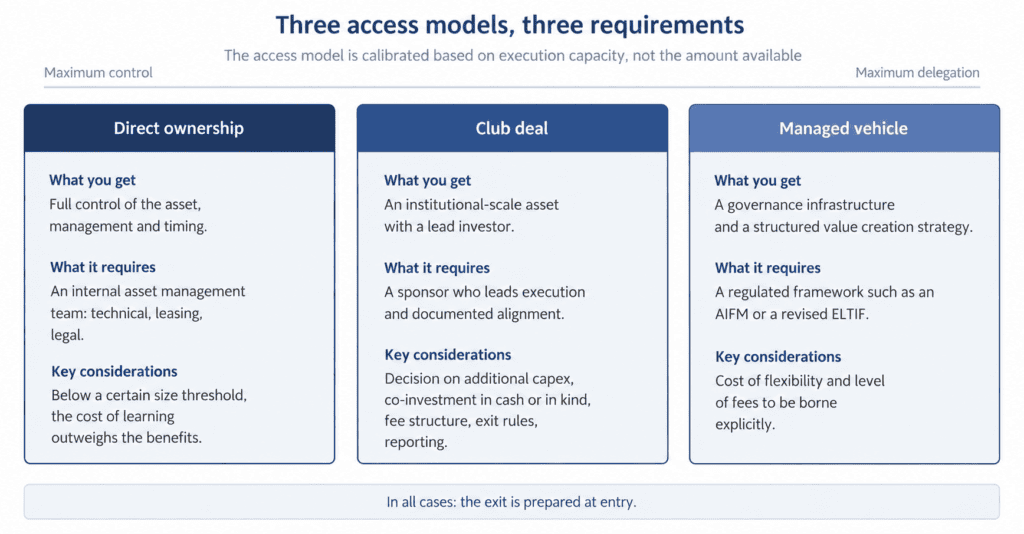
Direct ownership offers maximum control. However, it requires in-house asset management capability — technical, letting, legal — that is only genuinely available above a certain AUM threshold. Below that, the cost of learning is paid on the first deal.
The club deal is the middle path: access to institutional-scale assets with a controlled ticket and a sponsor carrying execution. The points to lock down are well known but rarely negotiated with sufficient rigour: governance and decision rights in case of additional capex, real sponsor alignment through cash co-investment, fee policy, exit rules, and treatment of a defaulting investor.
Managed vehicles under the AIFM framework, as well as revised ELTIF structures, provide governance and valuation infrastructure. Nevertheless, their flexibility and fee costs must be explicitly accepted.
[Visual n°9 — Diagram: three market access modes]
5. Risks and Caveats
Exit liquidity risk. The first risk mirrors the opportunity. Indeed, a market where the volume brought to market sometimes represents double or triple the amounts actually invested is a market where exit at the desired price is not guaranteed.
Pricing risk. Repricing is not complete. Buying at a discount to an appraisal value that may be lagging does not equate to buying low. The relevant reference is the recent comparable transaction, not the appraisal. This is precisely what we analyse in our article on the 2025–2027 real estate refinancing wall.
Execution risk. Capex cost and timing, as well as reletting timeframes, are systematically underestimated by buyers who do not operate assets themselves. A twelve-month delay on a reletting destroys a substantial portion of IRR.
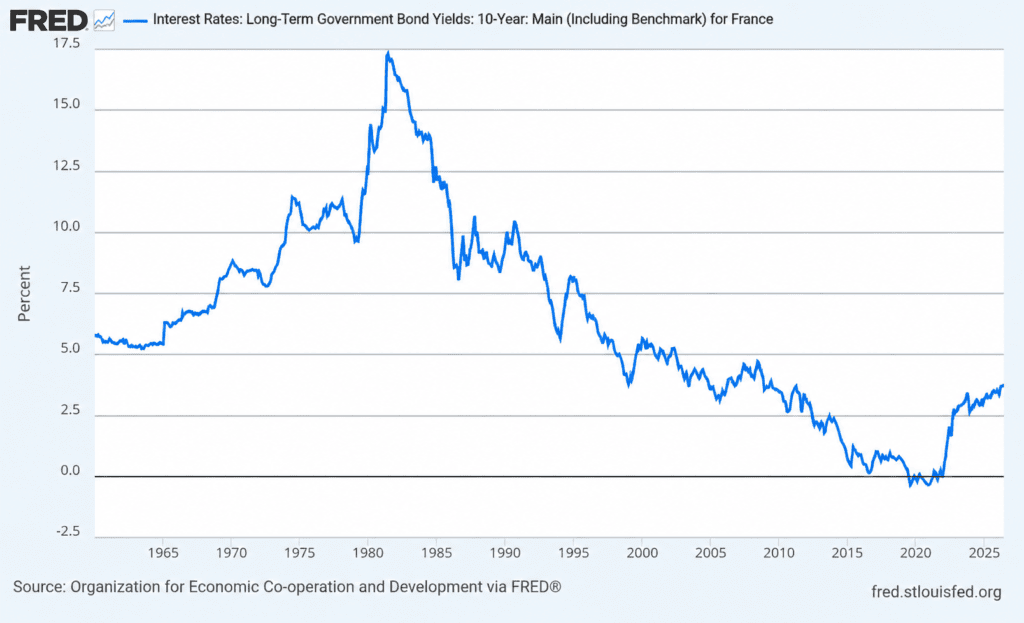
Financing risk. The French 10-year OAT reached 3.65% at end-June 2026, versus 3.22% at end-February, following the ECB rate hike in June. A business plan calibrated on anticipated rate easing is fragile.
[Visual n°10 — French 10-year government bond yield, long-term series]
Wealth concentration risk. Direct real estate diversifies poorly at family scale: a handful of assets is enough to concentrate exposure on one geography, one asset type, and one sponsor.
Club deal governance risk. Information asymmetry, absence of interim liquidity, sponsor conflicts of interest on fees and disposals: these are the most frequent flaws. They are addressed at documentation stage, not afterwards.
(For informational and educational purposes only. This does not constitute investment advice, legal advice, or tax advice.)
6. Implications for Private Debt and Structuring
The same institutional withdrawal that opens equity also opens debt. Financing private capital real estate acquisitions means taking a position on the same market thesis, but as a creditor. Thus, one benefits from additional contractual protection and less exposure to value. This is the framework we detail in our analysis of private real estate debt in France.
For a private investor, this position offers a specific advantage in the current context: it does not require knowing how to operate the asset. It requires knowing how to analyse it. This is a competence arbitrage as much as a risk one — equity on what you can manage, debt on what you understand without wanting to operate.
Three Requirements for Structuring Private Real Estate Debt
Three requirements frame this position. First, a DSCR stress-tested under durably elevated rate assumptions, not anticipated easing. Second, structural discipline calibrated to the deal: capex and interest reserves sized for the transition period, cash sweep on deviation, value covenants at quarterly rather than annual frequency, effective cash flow control. Third, genuinely effective security, whose enforcement does not depend on documentary grey areas. This is where fiduciary security in real estate financing plays a key role.
The complexity premium is all the more justified when backed by real control. Without that control, it is merely a headline yield.
Conclusion: Private Capital Real Estate — A Window That Rewards Execution
The window is real, but it does not reward capital availability: it rewards execution capability and tolerance for illiquidity. The family offices that will benefit are not those that paid the least. They are those that correctly identified the nature of the discount they were buying and prepared their exit before their entry.
This window will close with the return of institutional investors. That return will show up in volumes and mandate conversion rates long before it shows up in prices. This is therefore the indicator to watch for those who wish to be sellers rather than buyers when it occurs.
Sources
— Investissement immobilier en France au 1er semestre 2026 (communiqué, 6 juillet 2026). https://www.jll.com/fr-fr/newsroom/investissement-immobilier-france-s1-2026
— JLL — Investissement immobilier en France au 1er trimestre 2026 (communiqué). https://www.jll.com/fr-fr/newsroom/investissement-immobilier-france-t1-2026
— JLL — Marché de l’investissement immobilier en Île-de-France, T2 2026. https://www.jll.com/fr-fr/insights/market-dynamics/ile-de-france-investment
— Cushman & Wakefield — Marketbeat Investissement France, S1 2026 (PDF). https://assets.cushmanwakefield.com/-/media/cw/emea/france/insights/download-components/mb-invest/cw_france_marketbeat_investissement_s1_26.pdf?rev=5cb0b2f89b7d482abe5564015b122947
— ASPIM / IEIF — Collecte et performance des fonds immobiliers grand public au premier semestre 2026 (5 août 2026). https://www.aspim.fr/actualites/collecte-et-performance-des-fonds-immobiliers-grand-public-au-premier-semestre-2026/
— AFFO / EY — 11e Baromètre du Family Office (24 juin 2026). https://www.ey.com/fr_fr/newsroom/2026/06/presentation-du-11eme-barometre-de-l-affo-en-partenariat-avec-ey
— Banque de France — Les taux monétaires directeurs (dernière décision 23 juillet 2026). https://www.banque-france.fr/fr/les-taux-monetaires-directeurs
— Banque centrale européenne — Décisions de politique monétaire. https://www.ecb.europa.eu/press/pr/date/2026/html/ecb.mp260430~81b7179e6f.fr.html
— OCDE via FRED — Rendement des emprunts d’État français à 10 ans. https://fred.stlouisfed.org/series/IRLTLT01FRM156N