For a long time, the data center remained a niche asset. It was reserved for a handful of specialised operators and poorly understood by traditional real estate investors. Artificial intelligence has changed everything. Indeed, training and running AI models requires unprecedented computing capacity. Thus, data center real estate France has become one of the most sought-after segments in European real estate, and France now occupies a leading position.
However, the data center follows a different logic from other asset classes. Value is measured neither in square metres nor in location quality, but in connected megawatts. Scarcity is not land-based: it is electrical. Moreover, the primary risk is not vacancy, but technical obsolescence and dependence on a handful of tenants.This article describes the state of the French market, what drives the value of these assets, and the implications for those who finance them.
1. A Market Reshaped by Artificial Intelligence
From Colocation to Giant Campuses
The European data center real estate France market historically developed around five cities: Frankfurt, London, Amsterdam, Paris and Dublin. Professionals refer to them by the acronym FLAP-D. For a decade, demand came primarily from colocation: companies renting a few racks or a few hundred kilowatts to host their servers. Today, demand comes first from hyperscalers — the major cloud and AI providers. They lease entire buildings, or even campuses of several hundred megawatts.
The supply-demand imbalance is now clear. Average vacancy across FLAP-D markets stands at around 5%, versus nearly 17% in 2021. Three quarters of projects under construction are already pre-leased. In H1 2026, absorption reached approximately two thirds of the full-year 2025 volume, according to JLL. Furthermore, the four largest cloud players are expected to spend around $725 billion on capex in 2026, up more than three quarters year-on-year.
France’s Comparative Advantage in Data Center Real Estate
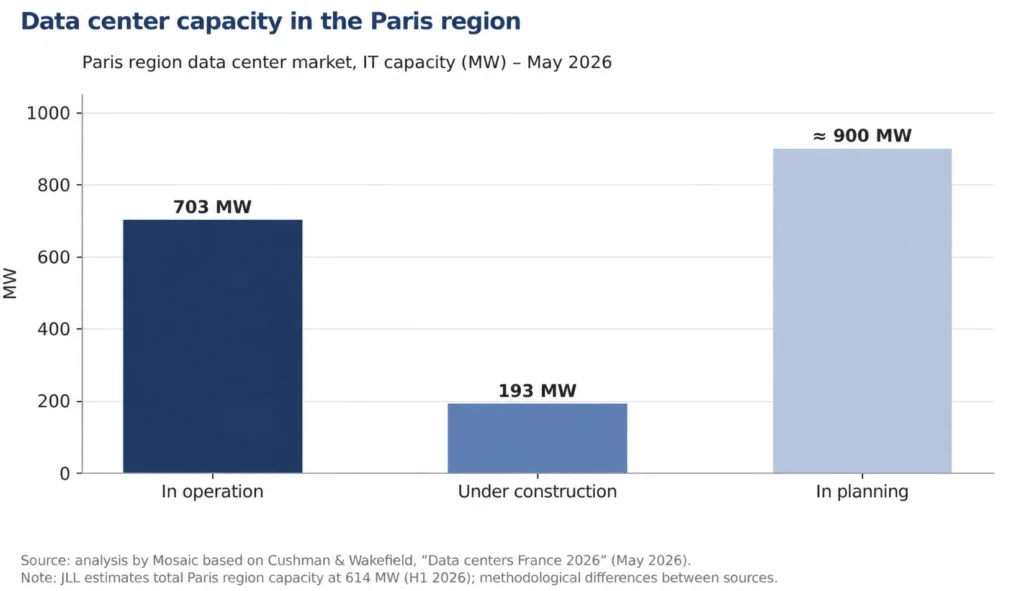
France has established itself as the second largest European market for data center investment, behind the United Kingdom. Approximately €9 billion has been invested since 2016, and market projections point to over €90 billion by 2035, according to Cushman & Wakefield. Installed capacity in the Paris region is between 600 and 700 MW. Nearly 200 MW are under construction and approximately 900 MW are in the pipeline.
[Visual n°2 — Data center capacity in the Paris region (MW)]
This position rests primarily on electricity. France’s power mix is over 95% decarbonised. Nuclear output has returned to high levels, and the country is a structural net electricity exporter. For a data center operator, this means three things: low-carbon energy compatible with hyperscalers’ climate commitments, dispatchable power, and capacity available at national scale. The French state has made this an industrial policy priority. At the AI Action Summit in February 2025, 35 sites were identified with local authorities, and €109 billion in investment announcements were made for the broader AI ecosystem. This figure covers far more than real estate: it should not be read as a data center investment volume.
2. The Megawatt: The New Unit of Value in Data Center Real Estate France
From Square Metres to Kilowatts
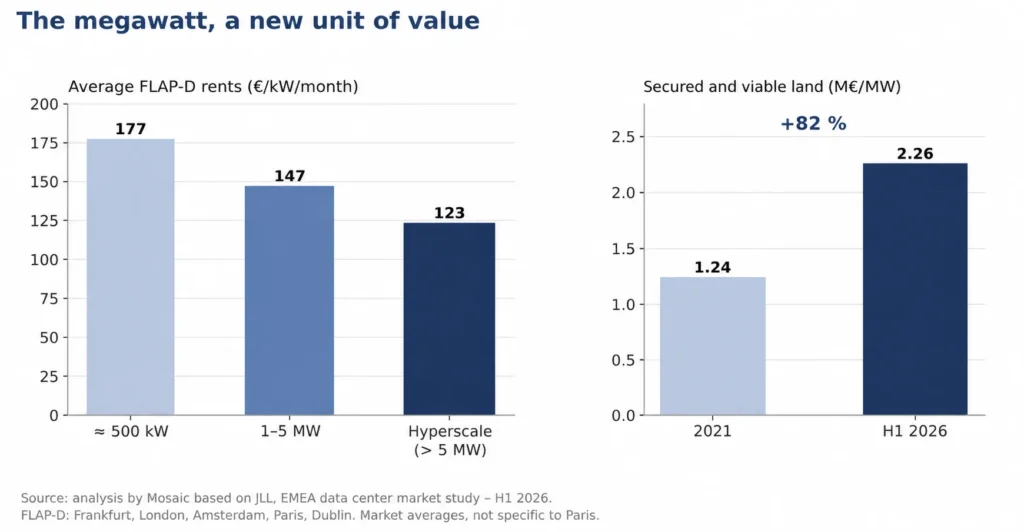
In data center real estate France, rent is expressed in euros per kilowatt per month, not euros per square metre. Across FLAP-D markets, it ranges from approximately €177/kW/month for small capacity (around 500 kW) to approximately €123/kW/month for a hyperscale contract above 5 MW. The volume discount is steep: large tenants negotiate wholesale pricing.
This logic extends to land value. A plot only has value if it can be connected to the grid. The price of serviced and connected land in major European markets has risen from approximately €1.2 million per megawatt in 2021 to approximately €2.3 million — an increase of over 80%. What you are buying is first and foremost secured electrical capacity.
[Visual n°4 — FLAP-D rents by contract size and connected land cost]
Consequently, projects are moving further from major cities. Hyperscale campuses now develop on average more than 170 km from historical hubs, versus less than 50 km previously. The share of greenfield projects in the 2026-2028 pipeline has risen from under 10% to nearly 40%. Location in the real estate sense matters less than proximity to a very high voltage substation.
Three Segments, Three Risk Profiles in Data Center Real Estate France
The term “data center” covers assets with very different profiles:
Hyperscale. Campuses of several tens to several hundreds of megawatts, leased to a single investment-grade tenant on long terms. The profile is close to infrastructure: predictable cash flows, but extreme concentration and significant tenant bargaining power.
Wholesale. Capacities of one to a few megawatts, leased to cloud operators, large corporates, or platforms. Leases are shorter and the tenant base more diversified. Rents have edged back 2-3% from their 2025 peaks.
Retail and edge. Small capacities, close to end users, leased to many clients. Unit rents are higher and continue to grow. However, management is more intensive and commercial risk more diffuse.
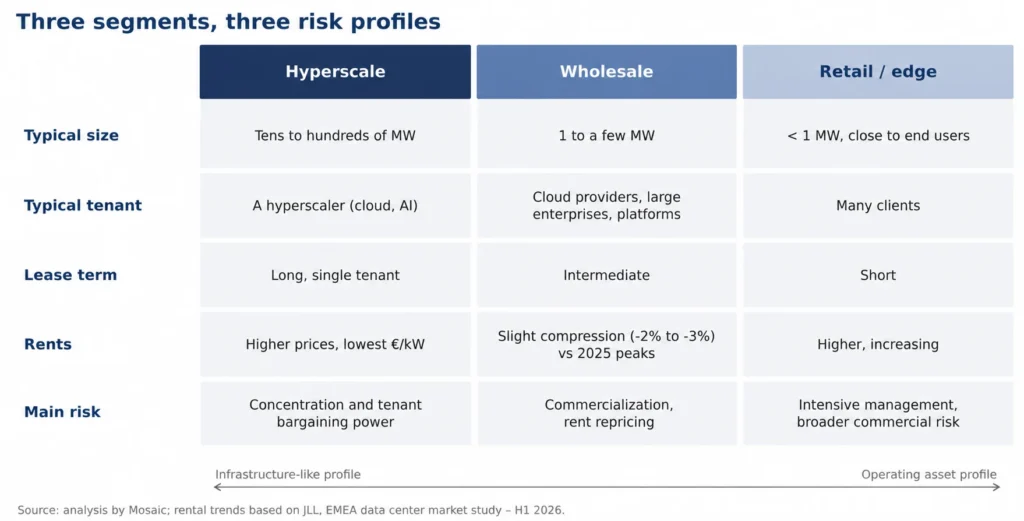
The same word therefore describes both a quasi-infrastructure asset and an operationally intensive asset closer to corporate hospitality. Credit analysis cannot be the same. This is precisely what we develop in our article on debt vs equity real estate allocation in 2026.
3. Grid Connection: Bottleneck and Barrier to Entry
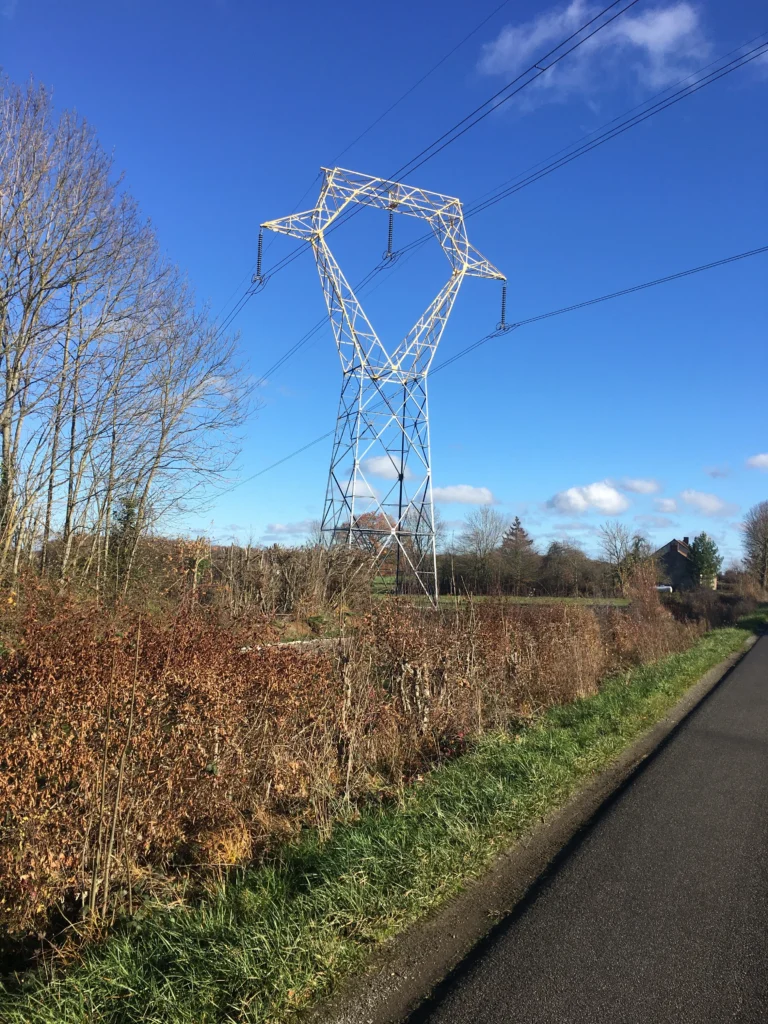
[Visual n°6 — 400 kV high-voltage transmission line]
A Queue Under Pressure
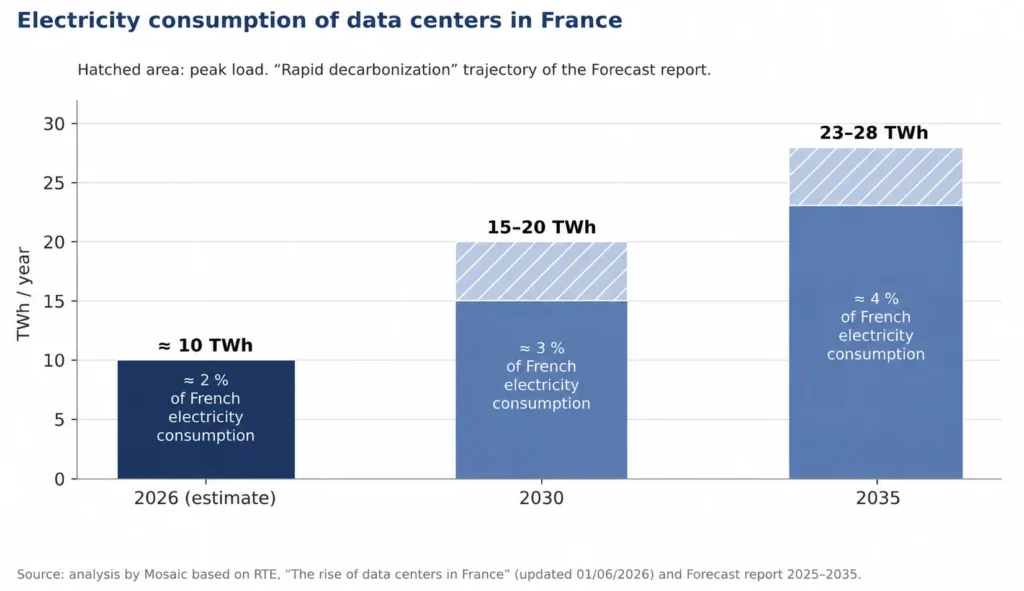
France’s energy advantage is real at national scale. It is far less obvious at the level of an individual substation. In May 2026, RTE had reserved nearly 18 GW of capacity for approximately 80 data center projects, versus around 5 GW for some forty projects at end-2024. Nearly 7 GW are located in Île-de-France and 6 GW in Hauts-de-France. For comparison, data centers currently consume approximately 10 TWh per year, representing nearly 2% of French electricity consumption. The grid operator’s projections point to 15-20 TWh by 2030.
[Visual n°7 — Capacity reserved by RTE for data centers, end-2024 and May 2026]
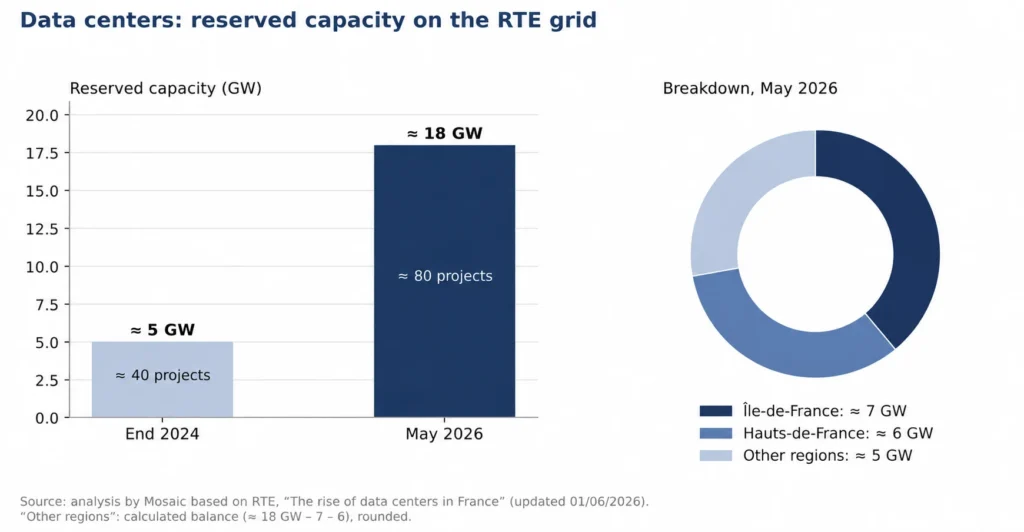
The gap between reserved power and actual consumption reveals a central phenomenon: capacity reservation has become an asset in itself, and therefore an object of speculation. Indeed, data centers connected two to three years ago use on average only around 20% of the power they originally requested. Across major European markets, grid connection lead times routinely exceed two years.
Fast Track and Maturity Priority in Data Center Real Estate France
Public authorities have responded on two fronts. First, an accelerated “fast track” procedure was approved by the French Energy Regulatory Commission (CRE) in May 2025. It targets very large consumers, from 400 MW to 1 GW, on sites pre-selected by the state close to the 400 kV network. Project sponsors benefit from accelerated connection and reduced extension costs, in exchange for commitments. The first contract was signed in January 2026 for a campus in Seine-et-Marne: 240 MW are planned by end-2027 and 700 MW by end-2029, with a long-term potential of 1.4 GW.
Second, the queue is evolving from a “first come, first served” logic toward priority given to the most advanced projects: secured land, financial guarantees, equipment orders placed. In parallel, the legal framework allows the grid operator to reduce connection capacity when actual power drawn remains durably below the requested level. For an investor, the message is clear: reserved capacity is no longer an acquired right. It becomes a conditional asset, lost if the project does not progress.
4. Key Takeaways for Data Center Real Estate France
- France is the second largest European market for data center investment. Its main advantage is decarbonised, dispatchable electricity available at national scale.
- Value is measured in connected megawatts: rents in €/kW/month, land valued per megawatt, campuses increasingly distant from major cities.
- Hyperscale, wholesale and edge present distinct risk profiles that require different credit analyses.
- Grid connection is the real bottleneck. Power reservations far exceed actual consumption, and regulation now prioritises mature projects.
- For a lender, the asset is analysed first by its electrical capacity, its tenant, and its technical risk — not its location.
5. Risks and Caveats
Technical and Letting Risks
Technical obsolescence. AI chips are dramatically increasing power density per rack. They increasingly require liquid cooling, whereas previous generations relied on air cooling. A building delivered a few years ago may require heavy investment to remain competitive. Therefore, the economic life of the asset may be shorter than the term of its financing. Furthermore, reversibility to another use remains very limited.
Tenant concentration. In the hyperscale segment, a single tenant often accounts for the bulk of revenue. The quality of their covenant is reassuring. However, their bargaining power at renewal, or their ability to fall back on proprietary campuses, creates a concentration risk that lease length does not fully neutralise.
Market and Regulatory Risks
Overcapacity. Power reservation volumes — far exceeding actual consumption — signal a speculative element in project pipelines. If hyperscaler capex were to slow — for example because AI monetisation takes longer than expected — unleased projects would be the first affected. The slight pullback in wholesale rents warrants caution on reversion assumptions, according to Les Énergies Renouvelables.
[Visual n°8 — Data center electricity consumption in France, 2026-2035]
Construction and execution. Lead times for electrical equipment (transformers, generators), technical complexity and dependence on the grid connection schedule: delay risk is high and costly, since the commissioning date determines when rent starts.
Acceptability and regulation. The concentration of projects in Île-de-France and Hauts-de-France is increasing local tensions around electricity, cooling water and land, in a context of zero net land artificialisation targets. Obligations are also tightening. Data centers are subject to the tertiary decree, with specific targets based on energy efficiency (PUE indicator). The European Energy Efficiency Directive also requires valorisation of waste heat above 1 MW, unless infeasibility is demonstrated, according to CMS Francis Lefebvre. These elements are provided for information only and do not constitute legal advice.
(For informational and educational purposes only. This does not constitute investment advice, legal advice, or tax advice.)
6. Implications for Private Debt and Structuring
Data center real estate France blurs the boundary between real estate debt and infrastructure debt. Large transactions already fall into the latter category: several European platforms have raised multi-billion euro financings from broad banking syndicates, as highlighted by DatacenterDynamics. These ticket sizes are beyond the reach of most club deal structures. Nevertheless, private real estate debt has a role to play, provided the right project phase and segment are chosen. This is the framework we detail in our analysis of private real estate debt in France.
Financing Data Center Real Estate France by Phase
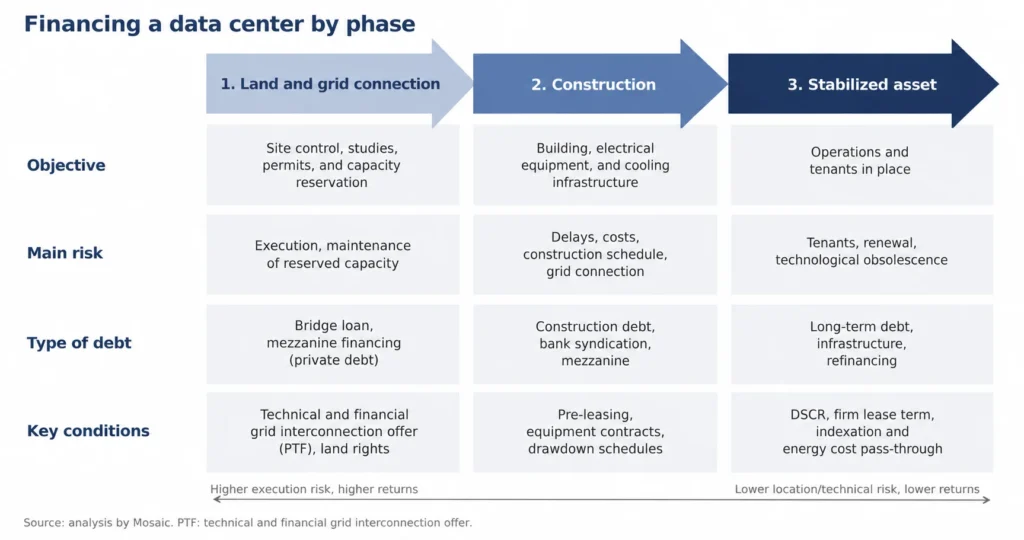
A data center’s lifecycle involves three stages with very different risk profiles: securing connectable land, construction, and leasing stabilisation. Upstream financing — land bridge, pre-financing of studies and connection commitments — is where banks are least active. Well-structured private debt can add real value here. It requires pricing commensurate with execution risk. This is also what we analyse in our article on the 2025-2027 real estate refinancing wall.
[Visual n°9 — Financing a data center by phase]
Deal-Specific Conditions Precedent in Data Center Real Estate France
Beyond standard security interests, fund disbursement must be conditioned on specific milestones: signed technical and financial proposal or grid connection agreement, energisation schedule, pre-leasing level, critical equipment contracts. Since connection capacity can be reduced in case of under-utilisation, its maintenance must be monitored as a security interest in its own right. In this regard, fiduciary security in real estate financing provides a particularly well-suited alignment tool between sponsor and lender.
Analyse the Tenant and the Megawatt, Not the Location
On a stabilised asset, the DSCR depends primarily on tenant covenant quality, the firm lease term, and indexation mechanisms including energy pass-through. LTV must be read with caution: appraisal values rest on cap rate assumptions that remain largely untested in France. The fallback value of the asset, in case of tenant departure, is low. This is precisely the analytical angle we develop in our article on alternative real estate financing.
Accessible Segments for Private Debt
For mid-market private debt, the most coherent opportunities likely lie in edge and small wholesale, in the conversion of already-connected industrial sites, and in the financing of land in the process of being secured. This requires technical expertise, or recourse to independent specialists, rarely deployed in traditional real estate.
Conclusion: Data Center Real Estate France — An Attractive Segment That Demands Method
The data center looks like real estate, but it is financed like infrastructure. In France, the energy advantage, state mobilisation, and AI-driven demand make it a durably attractive segment. However, this attractiveness rests on a scarce and regulated resource — the connected megawatt. It comes with risks that traditional analytical tools poorly capture: obsolescence, concentration, and speculation on capacity.
For lenders, the challenge is not to follow the enthusiasm but to adapt the method: reason by project phase, secure grid connection as a security interest, and analyse electricity and the tenant before square metres. Those who master this analytical framework will find in this segment financing opportunities that are both rare and well-compensated.
Sources
- Cushman & Wakefield — Data centers et IA : le renouveau d’un actif stratégique à l’horizon 2030
- JLL — EMEA Data Center Market Study, H1 2026
- RTE — The rise of data centers in France
- Les Énergies Renouvelables — Datacenters: how France powers the AI wave
- CRE — Fast track procedure
- CRE — Deliberation n°2025-120
- Élysée — AI Action Summit closing
- CMS Francis Lefebvre — Data centers: grid connection and energy efficiency
- DatacenterDynamics — maincubes secures billions in debt financing