Residential Development Financing: When Banks Step Back, Who Funds Land and Equity?
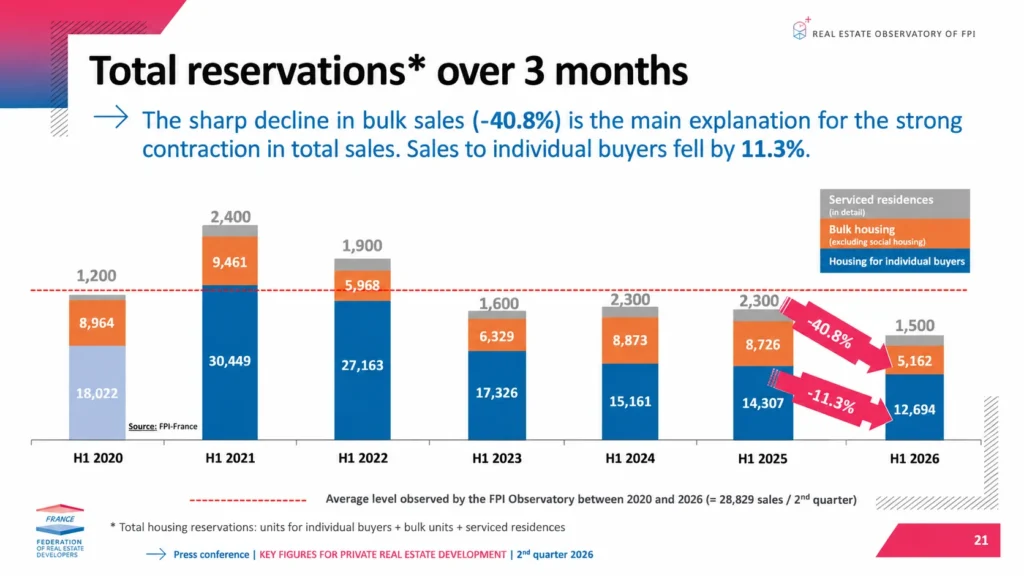
The French residential developer in 2026 faces three simultaneous shocks. The first is commercial. New housing reservations in the first half fell below 40,000 units — a level never previously recorded. Bulk sales collapsed by nearly 41% year-on-year in Q2. Residential development financing is thus at the heart of the sector’s concerns.
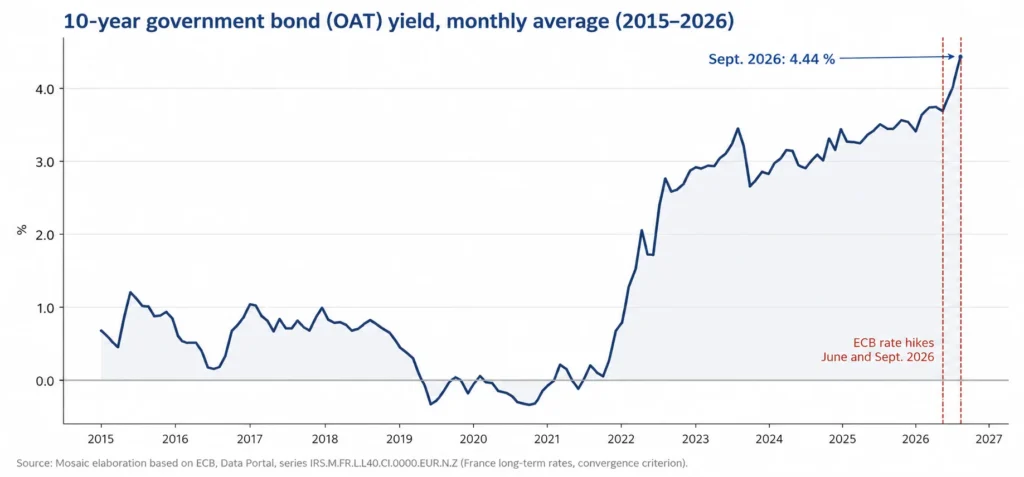
The second shock is monetary. The ECB raised its key rates in June and again in September, for the first time since 2023. The deposit facility rate returned to 2.50%, and the OAT has risen by more than 100 basis points since end-June, as we analyse in our article on the French OAT and prime real estate in 2026. The third shock is banking: lenders, more selective than ever, are demanding greater guarantees before committing.
Taken individually, these shocks would be manageable. Together, they call into question the financing model on which French residential development was built. The issue is no longer whether a scheme is profitable on paper. It is whether it can be financed end to end — from land acquisition to delivery — and at what cost.
This article describes the financing plan for a residential scheme in the current market. It identifies the gaps that banks no longer fill and the available structuring solutions, along with their limits.
1. A Residential Development Financing Model Built for a Market That No Longer Exists
The Classic Structure and Its Hidden Assumption
The financing of a development scheme traditionally relies on a well-established sequence:
- land is acquired or secured under a conditional sale agreement using the developer’s own equity;
- once planning permission is obtained and appeal periods have expired, the bank puts in place a developer loan;
- this loan is accompanied by a completion guarantee (GFA), essential for selling off-plan (VEFA);
- drawdown calls paid by buyers, staged according to construction progress, progressively repay the loan.
This structure is efficient because the developer deploys limited equity and recycles it quickly. However, it rests on an assumption rarely made explicit: rapid lot absorption. Sales fund construction, and construction proceeds at the pace of sales. When sales slow, the entire mechanism seizes up.
What Has Broken in Residential Development Financing
Q2 2026 data show precisely where the model has failed, according to FPI-France:
Sales to individuals. Owner-occupier purchases fell by nearly 18% year-on-year. Private investors grew 13%, but from very low volumes: FPI itself describes the rebound as fragile.
Bulk sales. This outlet — particularly to intermediate housing operators — had served as a buffer in 2023-2024. It has now collapsed.
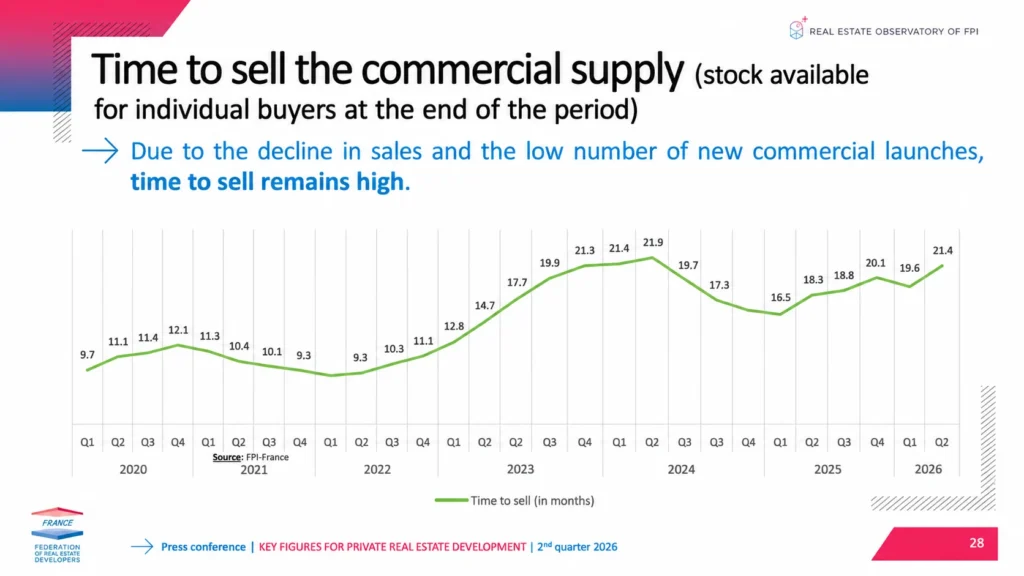
Supply and absorption. New launches fell by nearly 18% and the commercial supply stagnates at around 87,600 units. The absorption period has risen from 18 to over 21 months in a year. Completed but unsold units account for 9% of supply, versus a long-run average of 7%. Finished stock is the most costly segment for a developer to carry.
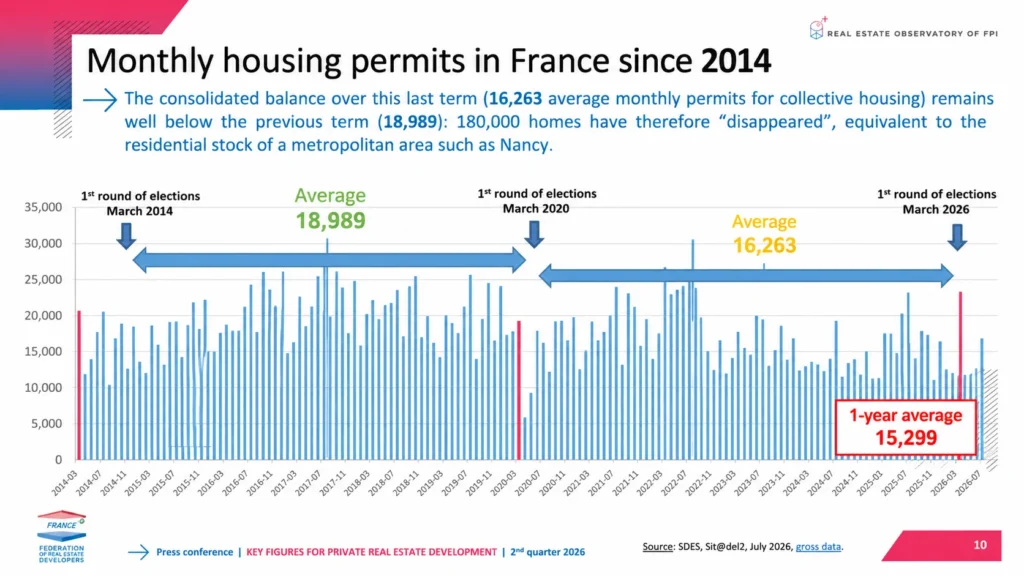
Furthermore, upstream signals remain mixed. Housing starts have bounced from a low, but 12-month authorisations remain 9.5% below the five-year average. The future project pipeline is not rebuilding at the pace of a genuine recovery, according to Empruntis.
The Bank’s Reading
For a lender, these figures translate into higher absorption risk and therefore stronger security requirements before committing. The levers are well known:
- a pre-sales threshold to be reached before the first drawdown;
- a minimum equity contribution from the developer;
- increased selectivity on scheme quality and sponsor track record;
- greater caution from GFA guarantee providers.
The exact thresholds vary by institution, location and developer covenant. However, the direction of travel is unambiguous: the slower the market, the more the bank expects the developer to demonstrate demand and commit its own capital first.
2. The Three Gaps in Residential Development Financing

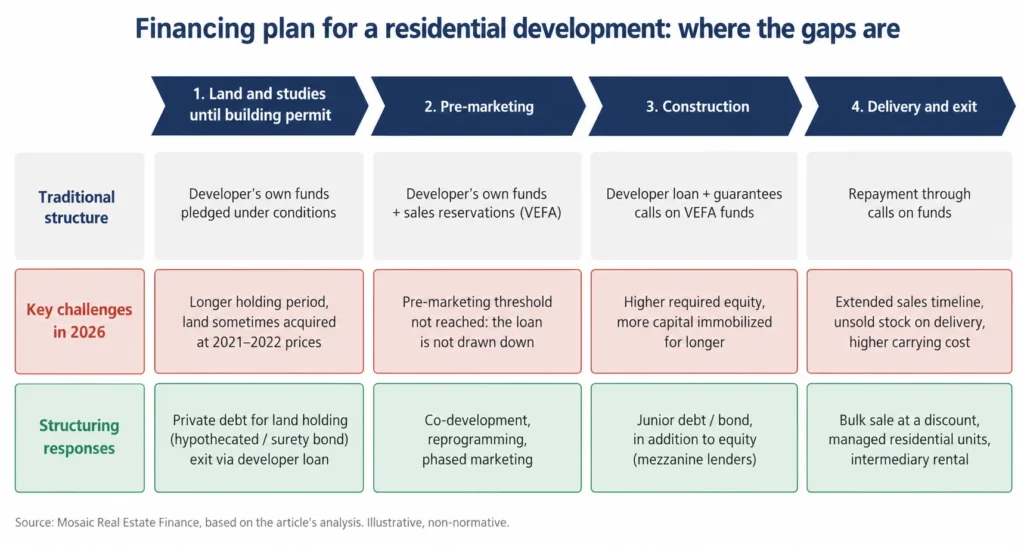
Land and Carry Before Planning Clearance
Banks finance very little — and often nothing — during the period before planning permission has been granted and all appeal periods have expired. Yet this is the longest and most uncertain phase. Land must be acquired or secured, studies funded, planning submitted, and instruction and appeal periods awaited.
In a liquid market, developers carried this phase on their own equity or with conditional sale agreements. In the current market, it is lengthening and tying up more capital. It also carries a specific risk: land acquired at 2021-2022 prices may no longer support the required margin at current exit prices. This is precisely what we analyse in our article on the 2025-2027 real estate refinancing wall.
The Equity Requirement Gap in Residential Development Financing
The second gap is mechanical. If banks require more equity per scheme and each scheme takes longer to absorb, the developer’s capital is tied up for longer across fewer projects.
Equity IRR falls, even with stable margins. A developer running several schemes in parallel must either reduce activity or find external equity. This is the framework we detail in our analysis of debt vs equity real estate allocation in 2026.
The Gap Between Required Pre-Sales and Actual Sales Pace
The third gap is the hardest to bridge. When the pre-sales threshold required by the bank is not reached, the developer loan does not trigger. The scheme then remains stuck between a granted planning permission and a construction site that cannot start. No financial instrument creates demand. Available solutions at best allow the scheme to be carried while commercialisation progresses, or its exit to be restructured.
3. Available Structuring Solutions for Residential Development Financing
Private Land Carry Debt
The first solution involves financing the phase before the developer loan through private carry debt — a bridge loan until planning clearance. Its typical characteristics:
Security. A mortgage over the land or a fiduciary security interest, the latter offering the advantage of protecting the lender in the event of developer insolvency proceedings.
Leverage. A loan-to-value ratio calculated conservatively on the land value, incorporating a scenario of resale without planning permission.
Exit. Repayment through the drawdown of the bank developer loan.
This financing costs significantly more than a bank loan, as it carries higher risk. It must therefore remain short-term, structured around clear milestones, and reserved for schemes where planning and commercialisation have a reasonable probability of success.
Quasi-Equity and Junior Debt
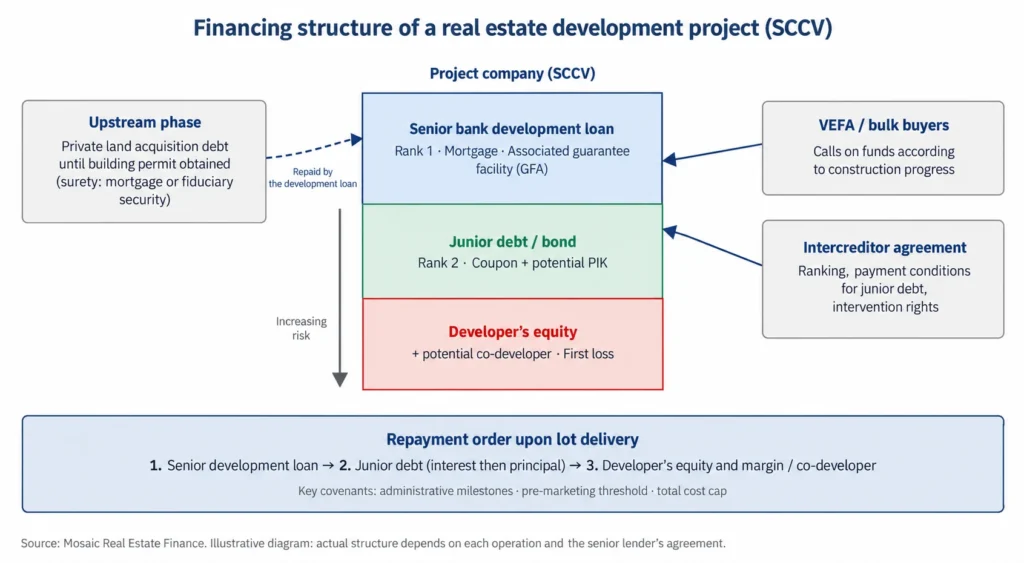
The second solution targets the equity gap. Subordinated debt supplements the developer’s contribution to reach the level required by the bank, provided the bank accepts it in its analysis framework. Several forms coexist: mezzanine, bond issuance, club deal.
The central issue is the articulation with the senior bank. An intercreditor agreement must specify ranking, repayment conditions and each party’s intervention rights. Consequently, the developer must reason in terms of total cost of capital, adding to the coupon all fees, any payment-in-kind (PIK) interest capitalisation, and governance clauses that restrict management flexibility. This is the framework we detail in our analysis of private real estate debt in France.
[Visual n°8 — Financing structure of a residential development SPV]
Co-Development
The third solution, often underestimated, consists of sharing the project rather than adding more debt. An equity investor — whether a REIT, a family office or another developer — takes a stake in the project company and shares the margin. The developer gives up part of its profit, but reduces its capital requirement and strengthens the scheme’s credibility in the bank’s eyes.
Restructuring the Exit in Residential Development Financing

Finally, the financing plan can be revisited by modifying the exit itself:
Bulk sale at a discount. This secures absorption at the cost of a reduced margin, in a market where this outlet has become scarce.
Reprogramming. A managed residence or intermediate rental housing scheme allows targeting a single institutional buyer rather than dispersed individual purchasers.
Phased delivery. This allows launching a first tranche as soon as its commercialisation justifies it, and deferring the remainder.
4. Risks and Caveats
Operational and Commercial Risks
Debt does not replace commercialisation. Financing the carry of a scheme for which demand does not exist amounts to deferring the loss while making it heavier. The first question is not “who can finance?” but “who will buy, at what price and within what timeframe?”
The cost of capital erodes the margin. Each additional month of carry, financed at a high cost, eats into a margin already under pressure. If the exit price cannot rise, the scheme enters a spiral where time works against it. The financing plan must incorporate degraded delay scenarios, not just the base case.
Exit depends on a third party. A land carry repaid through the developer loan assumes the bank will agree to lend when the time comes. This internal refinancing risk must be identified and, where possible, reduced through an in-principle agreement upfront.
Legal Risks in Residential Development Financing
Legal risks accumulate:
- planning appeals, which extend the carry period;
- articulation of the lender’s security with the GFA and buyers’ rights under VEFA;
- insolvency proceedings against the developer, which may freeze repayments depending on the type of security chosen.
The choice between a mortgage and a fiduciary security interest is not neutral on this last point.
(This content is provided for informational purposes only. It does not constitute legal, tax or investment advice.)
5. Implications for Private Debt and Structuring
For a private lender, the question is not to replace the bank but to finance the phases and tranches the bank no longer covers, at terms that reflect actual risk. Three criteria distinguish a financeable scheme:
Land at the right price. The land must have been acquired, or be under negotiation, at a price compatible with 2026 exit prices — not those of the previous cycle.
A credible administrative timetable. Planning is cleared, or its obtention rests on concrete milestones: advanced instruction, no known litigation, established dialogue with the local authority.
Real developer alignment. This means equity committed at first risk. A sponsor that does not put its own capital at stake transfers its risk to the lender.
A Phased Structuring of Residential Development Financing
Structuring must then be phased:
- a short carry until planning clearance;
- an organised relay with the developer loan, ideally provided for in an intercreditor agreement;
- operational covenants, more useful here than classic financial ratios such as DSCR, which are of limited relevance for a scheme with no rental income.
Useful covenants include: deadline for planning clearance, a pre-sales threshold to be reached, and a cap on total scheme cost overrun.
The Fallback Scenario
The lender must keep the fallback scenario in mind. If planning is not granted or the scheme does not launch, the lender must be able to resell the land. The loan-to-value ratio is therefore calculated on this fallback value — not on the theoretical value of the completed scheme — according to data from the Banque de France.
Conclusion: Residential Development Financing — A Question of Phase and Method
Residential development financing does not disappear. It breaks down by phase. The bank remains the natural financier of construction, once demand has been demonstrated. Upstream, land carry, equity top-up and the management of the waiting period now fall to other actors, at a higher cost.
In this market, the advantage does not go to the developer that raises the most capital. It goes to the one that knows how to buy time at a cost compatible with its margin, select its schemes carefully, and walk away from those that no longer work at current prices. Structuring can help navigate a difficult cycle, but it cannot make profitable a scheme whose cost base no longer matches the market.
Sources
- FPI-France — Observatoire de la promotion immobilière T2 2026
- FPI-France — Communiqué de presse T2 2026, 9 septembre 2026
- Empruntis — Logements neufs juillet 2026
- Auguste Patrimoine — ECB rate hike September 2026
- ECB — Data Portal, long-term rates France
- Banque de France — Housing loan overview, July 2026
- JLL — Real estate investment in France, Q3 2026