
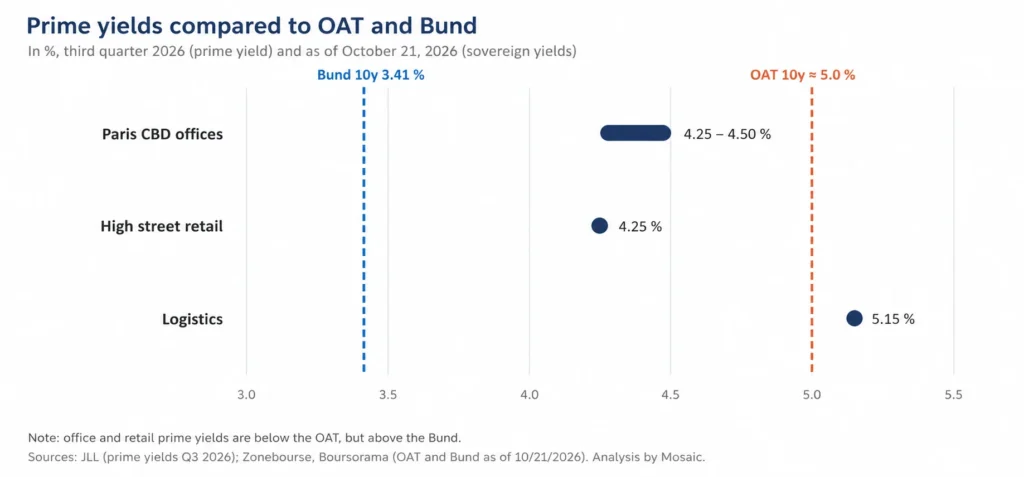
On 21 October 2026, the yield on the French OAT prime real estate benchmark — the 10-year government bond — crossed the 5% threshold for the first time since July 2002. At the same time, major advisors place the prime yield for offices in the Paris Central Business District between 4.25% and 4.50%. Thus, the most sought-after real estate asset in France now yields less than a 10-year loan to the French state.
For an investor trained in the market of the 2010s, where the spread between real estate yields and sovereign rates provided a comfortable cushion, this configuration is disorienting. It raises two distinct questions. Have prime real estate prices become disconnected from reality? Or has the reference rate stopped measuring only the cost of risk-free money? The answer directly conditions the allocation decisions of a family office between direct real estate, sovereign bonds, and real estate debt. This is precisely the analysis we develop in our article on the real estate risk premium in 2026.
1. An Inversion Unseen for Two Decades

The French OAT Prime Real Estate Inversion: The Facts
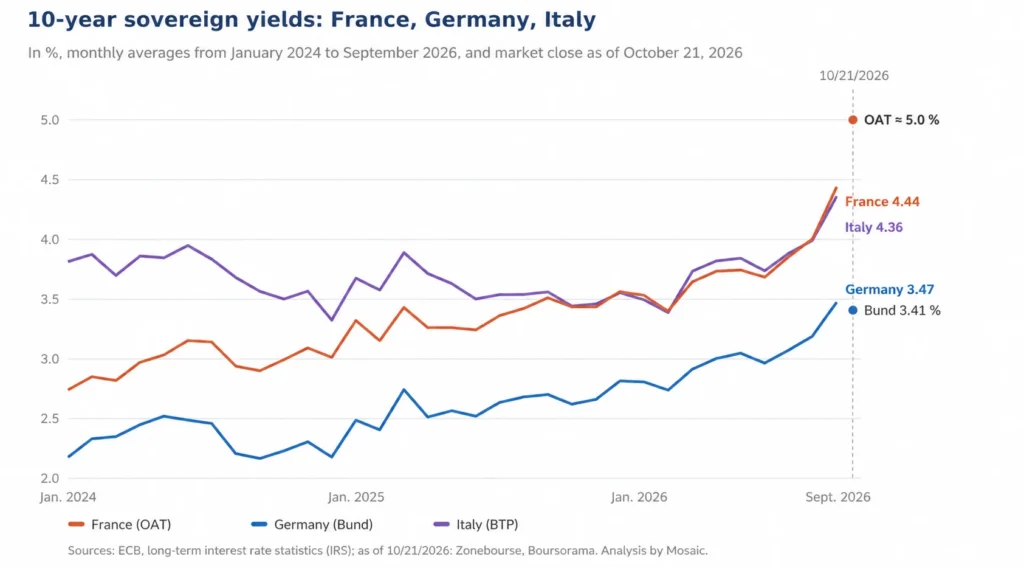
As of 21 October, the French 10-year OAT trades around 5%. The German Bund of the same maturity stands at around 3.41%. The spread between the two ranges between 150 and 160 basis points depending on the source. This is its highest level since the eurozone crisis, though it has not approached the November 2011 peak of around 225 basis points. In a sign of France’s singular position, the Italian 10-year BTP also trades below the OAT, at around 4.55%, according to Boursorama.
On the prime real estate side, JLL reports a 25 basis point rise in prime yields across all asset classes in Q3. CBD offices come in between 4.25% and 4.50%, high-street retail at 4.25%, and logistics at 5.15%. Against the OAT, these levels imply a negative spread of approximately 50 to 75 basis points for prime offices and retail. The spread is barely positive for logistics.
The Causes of the OAT Rise

The bond market move combines global and domestic factors. On the global side, the European Central Bank has returned to monetary tightening. After a first hike in June, it raised its key rates by 25 basis points on 10 September. The deposit facility rate was thus brought to 2.50%, according to Ymanci. Furthermore, rising energy costs and elevated sovereign issuance volumes are weighing on curves across the board.
On the domestic side, the review of the 2027 budget bill and mid-October social tensions are fuelling uncertainty. The prospect of the April 2027 presidential election reinforces this movement. France, rated Aa3 with a negative outlook by Moody’s and A+ by Fitch and S&P, remains under agency surveillance, according to Selectra. The Governor of the Banque de France described recent moves as “serious and concerning”, according to Club Patrimoine.
A Speed Asymmetry Between the OAT and French Prime Real Estate
The most instructive point lies in the pace of adjustment. According to JLL, the OAT has risen by more than 100 basis points since end-June. Prime yields have only been revised up by 25 basis points in Q3. The bond market reprices intraday; real estate reprices quarterly, through appraisals and rare reference transactions. Consequently, the current inversion is, at least in part, a timing artefact. It captures an instantaneous market rate against a real estate yield still estimated on earlier bases.
2. OAT or Bund: Which Risk-Free Rate for French OAT Prime Real Estate?

The Spread as a Country Risk Premium
The classic analysis of the real estate risk premium benchmarks the prime yield against the OAT, treated as the domestic risk-free asset. This convention assumes the OAT only compensates for time and anticipated inflation. However, with a 150-160 basis point spread over the Bund and a five-year CDS around 82 basis points, a significant portion of the OAT yield now compensates for sovereign credit risk, according to Zonebourse.
The Same Analysis Benchmarked Against the Bund
If the Bund is retained as the eurozone risk-free rate, the picture changes sign. Indeed, CBD prime offices then offer a spread of around 85 to 110 basis points, and logistics around 175 basis points. These spreads remain thin relative to history and to real estate’s illiquidity, but they are no longer negative. The debate is therefore not only about the price of Parisian real estate: it is also about the choice of benchmark.
Paris vs Europe on French OAT Prime Real Estate
At the European level, Cushman & Wakefield reports an average prime office yield of 5.44% in Q3, up 5 basis points, with prime rents up 5% year-on-year. Thus, Paris remains one of the most expensively priced markets on the continent in headline yield terms, even as its sovereign rate is now one of the highest in the eurozone core. This double singularity suggests the Parisian market has not yet fully absorbed the rate shock.
The Foreign Buyer Paradox
Nevertheless, international buyers remain active on trophy assets. The acquisition of Capital 8 by Pontegadea for nearly €875 million, and a Carrefour portfolio by GIC, are cases in point. These investors deploy long-horizon equity, with little or no leverage, and often reason within their own rate and currency framework. For them, the OAT is not the relevant opportunity cost.
3. What the French OAT Prime Real Estate Inversion Says About Prices
First Reading: The Adjustment Is Not Complete
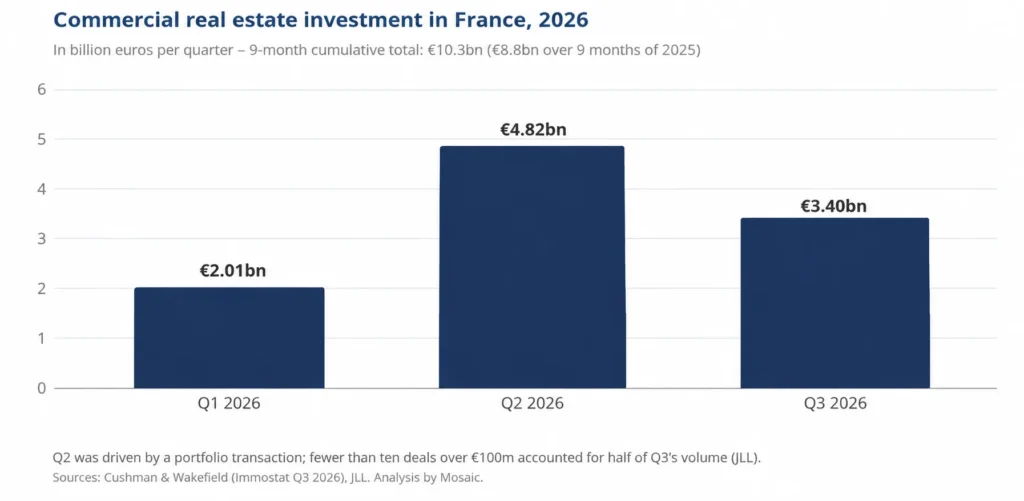
Commercial real estate investment volumes reached €10.3 billion over nine months, up year-on-year. However, the number of transactions fell 16%. Fewer than ten deals above €100 million accounted for half of Q3 volumes. Furthermore, according to JLL, nearly half of assets brought to market were withdrawn due to pricing disagreements. A market where sellers and buyers no longer meet is one where listed prices are, by construction, poorly informative.
Second Reading: Prime Is Not Bought for Its Current Yield
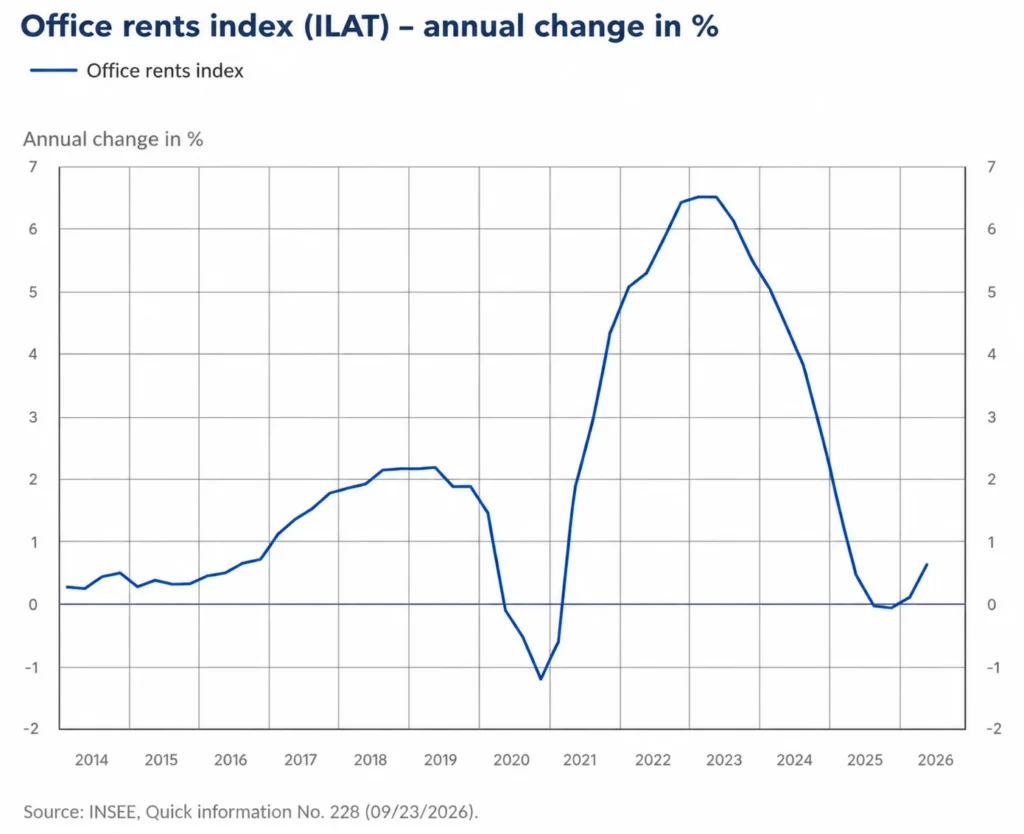
The counter-argument deserves serious consideration. A prime asset is not a bond: it offers exposure to rental growth, locational scarcity and a long-term wealth function. However, this reasoning has its limits. Indeed, the tertiary activities rent index (ILAT) rose only 0.63% year-on-year in Q2 2026, and average Île-de-France office rents edged lower according to Immostat. Indexation no longer provides, in the short term, the protection it offered in 2022-2023. Justifying a yield below the OAT therefore requires prime rental growth well above indexation — something only a handful of locations can credibly claim.
The Blind Spot: the Mid-Market

The €10-50 million segment concentrates the problem. It relies more heavily on bank financing and attracts fewer unlevered foreign investors. Moreover, it suffers, according to JLL, from a critical liquidity shortage. This is the segment where value adjustment is likely to be most pronounced, and most delayed, for lack of reference transactions. This is also what we analyse in our article on private capital real estate in 2026.
4. Key Takeaways
- The French 10-year OAT reached 5% on 21 October 2026, above the prime CBD office yield (4.25%-4.50%).
- A growing share of that yield compensates for sovereign risk: the OAT-Bund spread ranges between 150 and 160 basis points.
- Benchmarked against the Bund, the prime office risk premium remains positive, but thin.
- Bond yields have risen more than 100 basis points since end-June; prime yields only 25 basis points: real estate adjustment is lagging.
- Tertiary rent indexation, at around 0.6% year-on-year, no longer compensates for the rate gap.
- The mid-market, dependent on leverage, is the most exposed segment.
5. Implications for the Wealth Investor
Leverage Has Become a Yield Destroyer in French OAT Prime Real Estate
When the all-in cost of senior debt exceeds the asset yield, leverage works in reverse: each borrowed euro dilutes equity returns rather than enhancing them. With sovereign rates at 5%, fixed-rate financings are approaching or crossing this threshold for a large part of the prime market. Consequently, a leveraged acquisition of an asset at 4.50% only makes sense with an explicit value-creation thesis: repositioning, rental uplift, or conversion.
A Three-Bucket Allocation
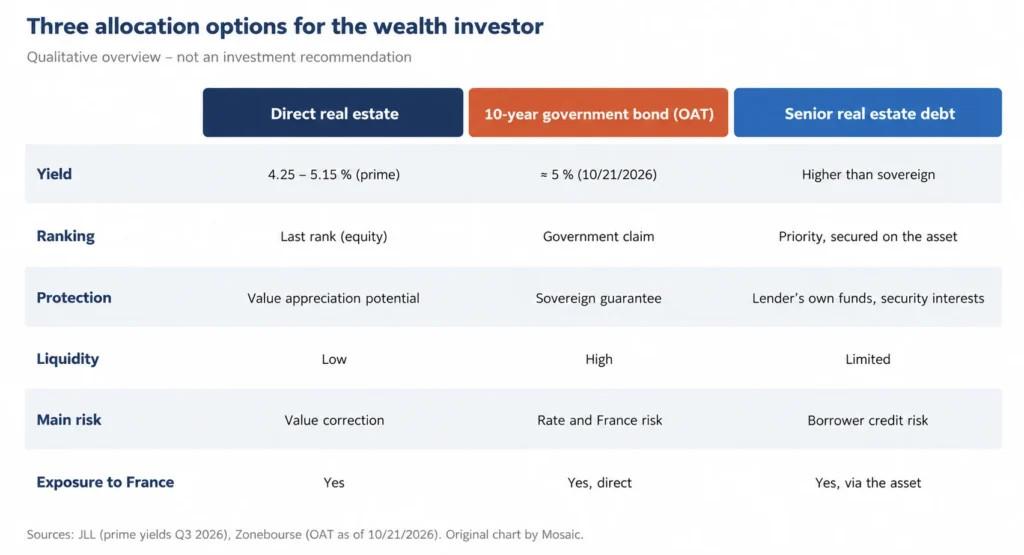
The wealth investor now has three exposures with comparable yields but different risk profiles. Direct real estate offers the appreciation option but low liquidity and values that are probably still overestimated. The OAT offers liquidity and a 5% yield, but carries France risk itself. Real estate debt offers a yield above the sovereign, a senior position on the asset, and an equity cushion provided by the borrower — at the cost of limited liquidity and credit risk to be analysed deal by deal. This is the framework we detail in our analysis of private real estate debt in France.
Domestic Concentration Risk
A portfolio invested in OATs, direct French real estate, and predominantly French SCPI units is not diversified: it is exposed three times to the same country risk. The MSCI French real estate investment barometer notes that a majority of respondents are planning to increase disposals, according to Savills. This moment calls for a careful examination of the actual correlation between the different buckets, beyond their asset class labels.
6. Risks and Caveats
Market and Sovereign Risks
Rate volatility. A peak at 5% can reverse quickly. Budget adoption, a pause in forthcoming ECB decisions, or a ratings agency reprieve would ease the OAT and mechanically reopen the risk premium.
Adverse rating scenario. A downgrade could widen the spread over the Bund further. Some analyses point to 175-200 basis points in a downside scenario, with knock-on effects for rating-constrained investors, according to Journal du Coin.
Real Estate and Data Risks
Delayed revaluation of retail vehicles. Year-end appraisals could weigh on SCPI and OPCI unit values, while pending redemption requests remained significant in Q1, according to La Centrale des SCPI.
Data fragility. Prime yields are estimates on a thin market. OAT-Bund spread readings vary by source and timestamp, according to Idéal Investisseur.
(This article is strictly informational and does not constitute investment advice, legal advice, or tax advice.)
7. Implications for Private Debt and Structuring
The inversion first changes the relative return equation for French OAT prime real estate. A senior loan backed by a quality asset, with a conservative LTV, now offers a yield above the OAT while benefiting from an equity cushion. For an investor who accepts illiquidity, the lender position thus becomes more efficient than the owner position. This is precisely the angle we develop in our article on debt vs equity real estate allocation in 2026.
It also imposes reinforced structuring discipline:
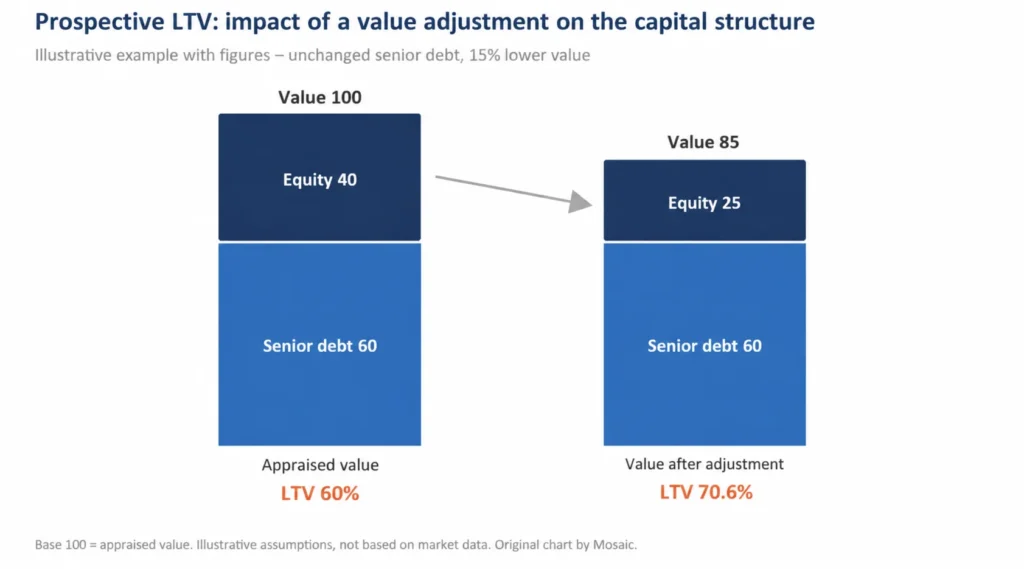
Forward LTV. Calibrate the ratio on an anticipated post-adjustment value, not the latest appraisal, given the observed lag between rates and values.
Coverage stress test. Test DSCR and ICR at rate levels above current levels, and explicitly arbitrate between fixed rate, floating rate, and hedging.
Mezzanine financing. Upcoming refinancings will reveal needs for additional equity. Mezzanine and preferred equity become completion tools, to be priced commensurate with the risk.
Security interests. In a market with uncertain values, the quality of security — from pledge to fiduciary security — becomes a central determinant of loss given default.
Conclusion: French OAT Prime Real Estate — A Redefinition of the Price of Risk
The OAT moving above the prime yield does not mean real estate has become a bad asset class. It signals that the price of risk is being redefined on two simultaneous fronts: a French risk-free rate that is no longer entirely risk-free, and real estate values that have not yet absorbed the rate shock. For the wealth investor, the question is no longer only whether to buy, but at which level of the capital structure to position. In the current configuration, the answer tilts toward senior, secured, and correctly priced positions.
Market data as of 21 October 2026.
Sources
- Boursorama — French OAT yield hits 5% for the first time since July 2002
- Zonebourse — OAT crosses 5%: France pays the price of political instability
- Journal du Coin — French debt: OAT nears 5%, banks retreat
- Idéal Investisseur — French debt: OAT at 4.03% and spread vs Germany
- Club Patrimoine — OAT near 5%, Banque de France issues warning
- Selectra — Moody’s review of France’s credit rating
- Ymanci — ECB raises rates again in September 2026
- ECB — Long-term interest rate statistics
- JLL — Real estate investment in France, Q3 2026
- Cushman & Wakefield — Immostat Q3 2026
- Refrance — ImmoStat Q3 2026
- Cushman & Wakefield — DNA of Real Estate Q3 2026
- Savills — European Investment Nowcast Q3 2026
- INSEE — Tertiary activities rent index, Q2 2026
- La Centrale des SCPI — SCPI market in 2026